
 Need help?
Do you have a question about the Weinig Profimat 23 E and is the answer not in the manual?
Explanation of warning symbols used in the manual to indicate hazards and precautions.
Essential guidelines for safe operation and handling of the machine.
Specific safety precautions when changing or using machine tools.
Safety measures for cutting operations with saws or profile cutters.
General safety advice covering various aspects of machine operation.
Specifies the machine's design purpose and permissible applications.
Procedures for preparing the machine for operation, including tool changes.
Steps for operating the machine in production mode, including setup and shutdown.
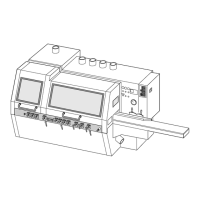
Identifies main machine components and controls with numbered references.
Describes the function and operation of the main power switch.
Details the functions of various buttons and indicators on the control panel.
Illustrates manual controls for spindle positioning and adjustments.
Explains controls located on the machine console for specific functions.
Details the operation and settings of the pneumatic control system.
Crucial safety guidelines for handling and fitting machine tools.
Step-by-step instructions on how to properly mount various tools onto the spindles.
Summarizes key settings for machine configuration and calibration.
Guides on adjusting spindle positions relative to fences and tables for accurate cuts.
Safety measures to be taken during the basic setting and adjustment process.
Instructions for adjusting the infeed table and edge jointing fence for chip removal.
Specific setup procedures for the optional rebate cutter attachment.
Detailed settings for the right-hand spindle, including axial and radial adjustments.
Detailed settings for the left-hand spindle, including axial and radial adjustments.
Guides for setting up the top spindle, including radius and height adjustments.
Instructions for setting up the bottom spindle, including chip removal and axial/radial adjustments.
How to set up and use the universal spindle in various configurations.
Adjusting the feed beam and its motor-driven functions for optimal timber processing.
General guidance for setting up tools to create profiled wood pieces.
Procedure for creating a test piece to verify and correct tool settings.
Method for matching tool settings to an existing sample profile.
Using auxiliary tools like rulers for precise profile setup.
Specific setup for tools that maintain a constant axial position.
Setting tools based on determined axial and radial values for dimensioned profiles.
Instructions for lubricating the table and workpiece transport system.
Details on fitting and adjusting the feed assembly for short workpieces.
Adjusting the feed roller shaft width for different feed roller widths.
Setting the guiding knife for accurate workpiece guidance in the spindle area.
Procedure for clamping and releasing tools using the hydraulic spindle nut.
Explains the air cushion system and how to adjust its width.
Instructions for fitting and setting up the sawing unit for glazing beads.
Setup and operation of the bevel unit for creating bevels on workpieces.
How to set up the groove guide for accurate workpiece guidance during grooving.
Lists limit switches, their functions, and locations for diagnostics.
Methods for identifying and diagnosing snipes on workpieces.
Common workpiece defects, their causes, and remedies.
Common issues related to tools, their causes, and solutions.
Troubleshooting guide for electrical issues and common faults.
Provides technical specifications and installation diagram information for the machine.
Calculation and guidelines for determining the total space needed for machine setup.
Information on foundation requirements and details for machine transport.
Specifies workpiece dimensions, feed mechanisms, motor ratings, and speeds.
Data on noise and dust emission levels measured during machine operation.
Overview of protective features, safety functions, and emergency stop systems.
Guidelines for safe delivery, crating, and lifting of the machine.
Procedures for installing and aligning the machine on its foundation.
Steps for connecting electrical and pneumatic systems and initial machine startup.
Information on connecting and operating the dust extraction system.
Basic principles for maintenance, including safety and lubrication.
A detailed schedule for lubricating machine components with recommended products.
Instructions for using the optional central lubrication system.
Procedures for performing regular maintenance checks and tests on machine parts.
Visual overview identifying lubrication points on the machine.
A cross-reference table for various lubricant brands and types.
Specific tasks for maintaining spindle drives, including belt tensioning.
Maintenance procedures for the feed gear, including oil level checks.
Lubrication guidelines for the machine's threaded spindles.
 General
| Spindle Configuration | Bottom, Right, Left, Top |
|---|---|
| Number of Spindles | 4 |
| Spindle Speed | 6000 RPM |
| Working Width | 230 mm |
| Working Height | 120 mm |
| Machine Type | Moulder |
| Max Workpiece Height | 120 mm |

 To Next Page