Preventive Maintenance
104 Progressa+ Bed Instructions for Use (216321 REV 2)
SURFACE INSPECTION INSTRUCTIONS
2. Make sure the life expectancy of the top cover and surface have not been exceeded. See “Expected
Life” on page 106 for the life expectancy of these components.
3. If the top cover has not exceeded its life expectancy, examine the outer cover for signs of abrasion,
cuts, tears, and fluid ingress.
a. If the top cover is compromised or fluid ingress is evident—
– Evaluate the top cover for additional contamination. If the contamination is localized,
replace the component(s) affected. Refer to the applicable service manual.
– If the component is not replaceable, discard and replace the top cover.
b. Check the seams, frame attachments and zippers for integrity.
4. If the surface has not exceeded its life expectancy, examine the assembly for fluid ingress and foam
delamination (you may need to remove the fire barrier first).
a. If fluid ingress is evident (see step 3a)—
– Examine the inside of the top cover for any sings of fluid ingress. Areas of discoloration are a
sign of fluid ingress.
b. If foam delamination is present, replace the component.
c. If a deformity is in the foam—
– Around the edges, make sure the deformity does not compromise the fit of the surface to
the frame. This may be determined by evaluating the surface to the Hospital Bed System
Dimensional and Assessment Guide to Reduce Entrapment.
Some deformation is normal as the surface ages.
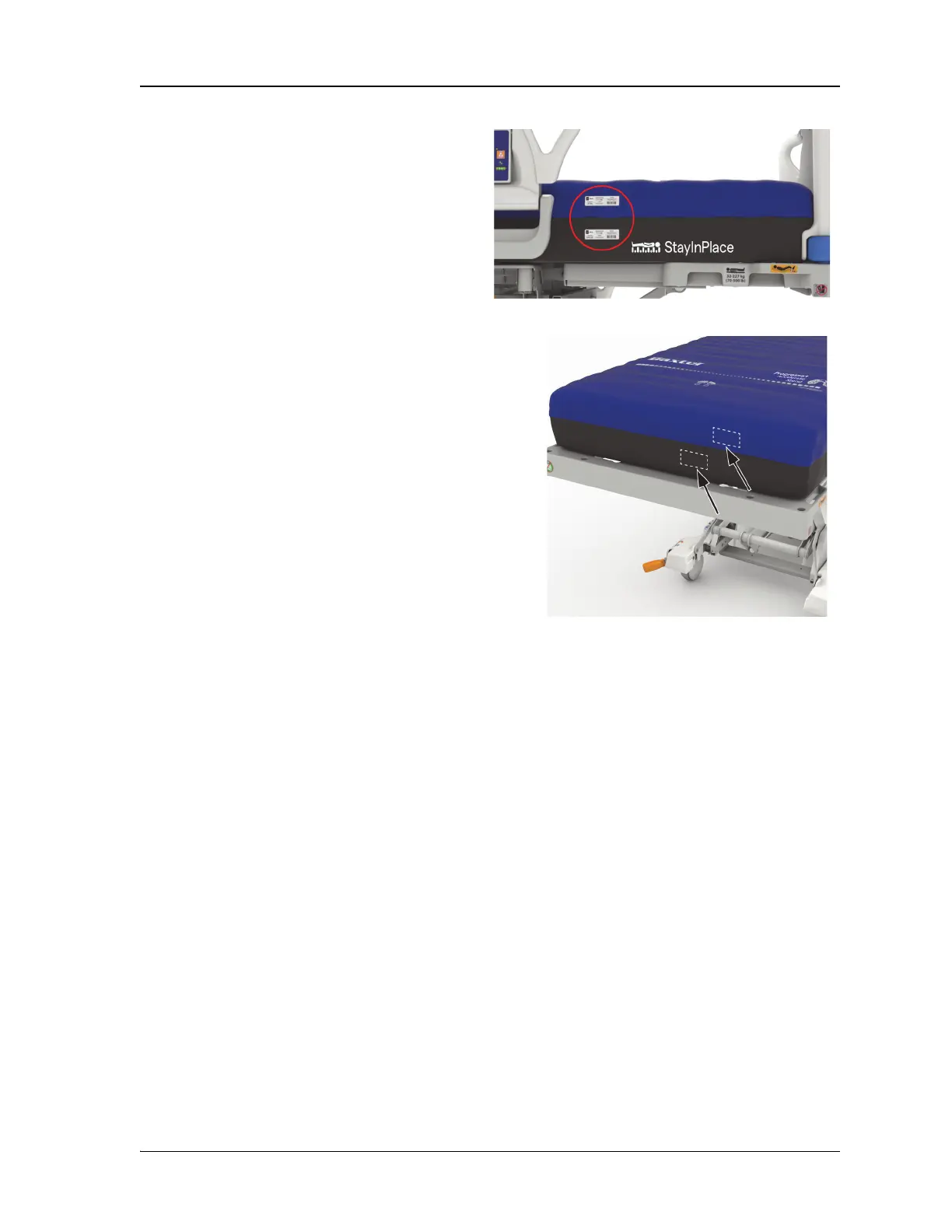
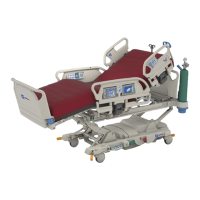
1. Look at the product information label on the
top and bottom covers to determine the age
of the top cover and rest of the surface. The
label is on the right side at the foot-end of the
top and bottom covers.
The Advance Surface and Accelerate Surface have two
RFID tags, one in the top cover and the other in the
surface. Baxter Service persons use these tags to locate
the product and to determine the ages of the top cover
and surface life.





 To Next Page