Bed Frame Features
82 Progressa+ Bed Instructions for Use (216321 REV 2)
1. Develop guidelines for all patients that indicate:
• Which patients may need to be restrained and the appropriate restraint to utilize.
• The proper method to monitor a patient, whether restrained or not, including time interval,
visual check of restraint, etc.
2. Develop training programs for all caregivers concerning the proper use and application of
restraints.
3. Maintain the bed at its lowest position whenever a caregiver is not in the room.
4. Clarify the need for restraint devices to families or guardians.
FLUOROSCOPY/C-ARM
Warning—To help prevent injury and/or equipment damage, obey these warnings:
• Warning—Use of surface radiolucency in areas with identified artifacts is not intended for
diagnosis of underlying pathology. Intended use in the identified artifact areas, for example,
includes tracking location of a radio-opaque component of a vascular central line.
• Warning—Hillrom does not indicate the use of the Progressa+ Bed with any particular
portable CT scanner. Contact the portable CT scanner manufacturer to make sure of the
compatibility with the bed and patient stability.
The bed provides a radiolucent head section that measures 17.7" x 24.8" (45 cm x 63 cm). The
radiolucent head section allows a caregiver to perform fluoroscopy of patients from head to waist when
the patient is lying flat.
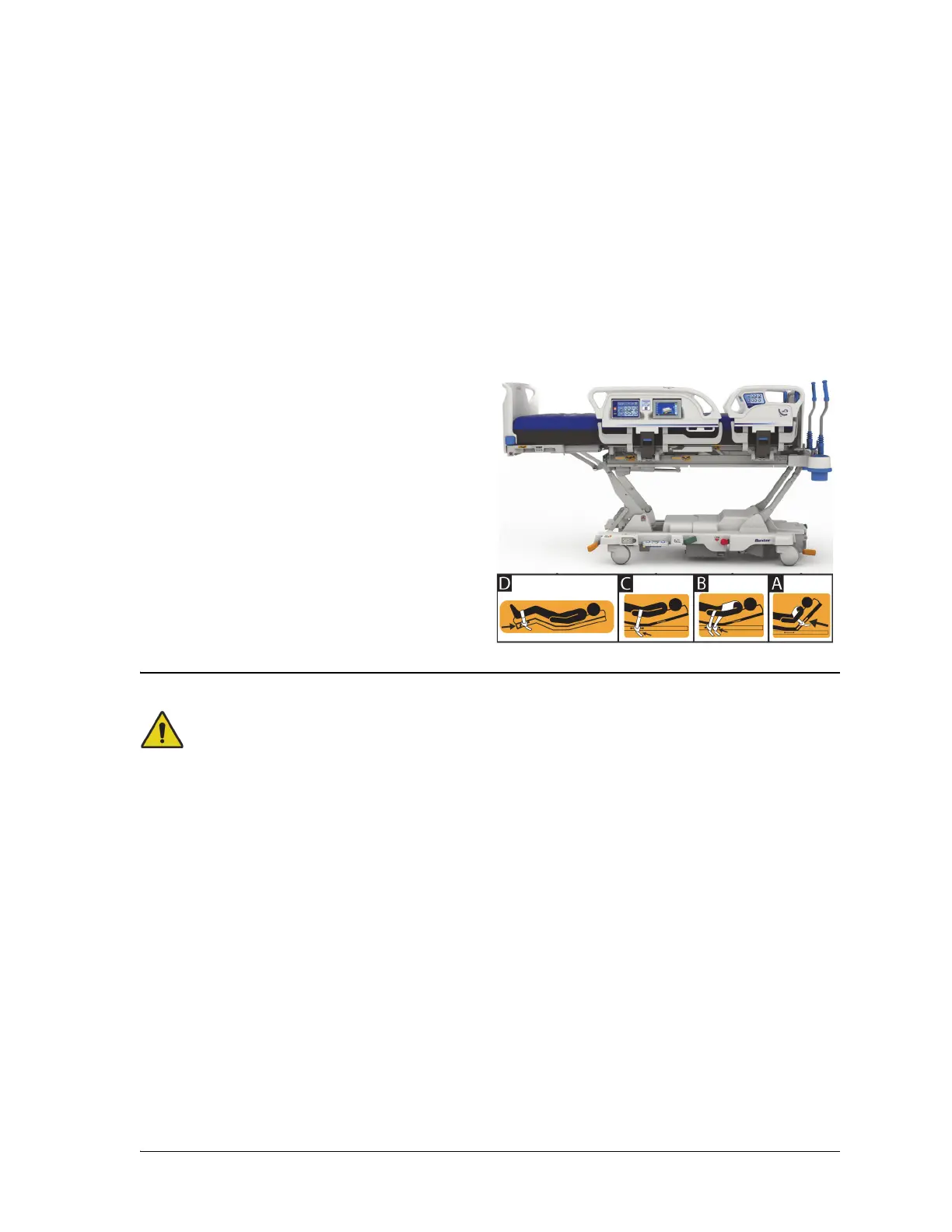
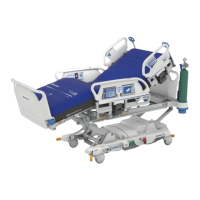
The bed facilitates the use of vest, wrist, waist, and ankle restraints. Baxter makes no recommendation
regarding the use of physical restraints. Users should refer to legal restrictions and appropriate facility
protocols before physical restraints are used. Ankle restraints can be tied to the designated ankle
restraint holders and also to the drainage bag holders on the foot section of the bed.
– Vest (A)—slot in the head section
(under the surface).
– Wrist/Vest (B)—Metal bar near the
middle of the upper frame.
– Wrist (C)—Metal bar on the upper
frame under knee section.
– Ankle (D)—Corner of the foot section.





 To Next Page