9.5 Individual tests
Testing
5284 / 08/2023 enBENNING ST 755+ / ST 760+84
9.5.4 Testing the contact current
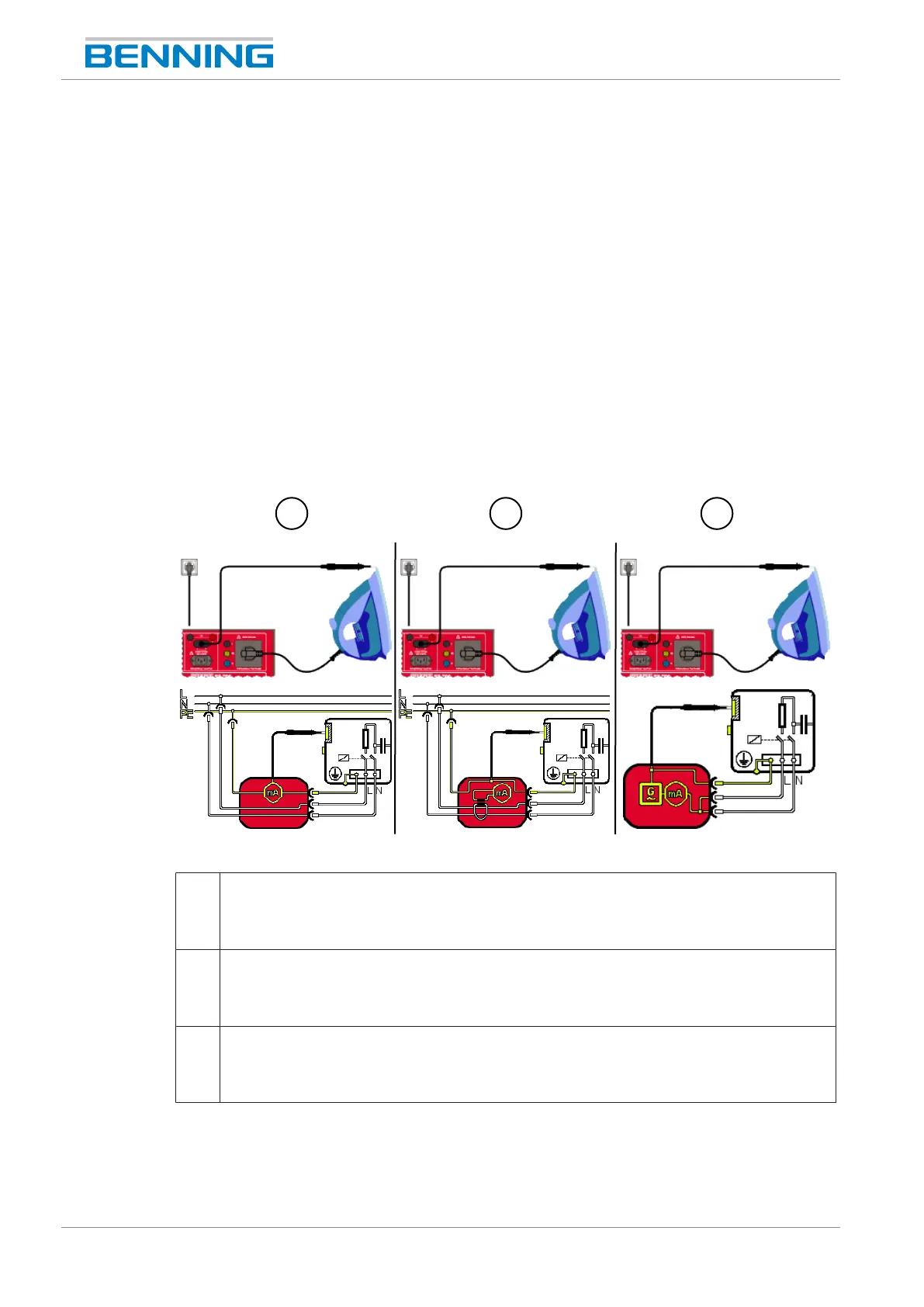
The contact current test [}page44] is intended to check the test sample for contact current on
every accessible conductive part without protective conductor connection. This is to ensure that
there is no risk of a dangerous electric flow via accessible conductive parts.
Requirements
• Approved safety measuring lines
• Please observe the requirements for measuring [}page71].
• The test sample is disconnected from the mains.
• Make sure that you are familiar with the procedure for manual [}page77] and automatic
[}page76] testing.
• The test sample has passed the insulating resistance test [}page80].
• Make sure that you know the necessary measuring points.
• The test sample is connected according to the connection diagram.
Figure17: Testing the contact current, ClassI (connection diagram exemplary for VDE0701 and
VDE0702, circuit diagram)
1 Direct current measuring method (ClassI, I
Cont
)
The shock-proof plug of the test sample is plugged into the test socket of the device.
Use the test probe for measuring on all accessible conductive components of the test
sample without PEconnection.
2 Differential current measuring method (ClassI, I
Cont
)
The shock-proof plug of the test sample is plugged into the test socket of the device.
Use the test probe for measuring on all accessible conductive components of the test
sample without PEconnection.
3 Alternative leakage current measuring method (ClassI, I
Cont
)
The shock-proof plug of the test sample is plugged into the test socket of the device.
Use the test probe for measuring on all accessible conductive components of the test
sample without PEconnection.



 To Next Page