Page 5 of 6
Menus
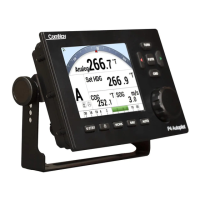
Several changes have been made in the user interface since the initial release of P4 Head to give more
intuitive operations to users. This section provides information on these changes.
Entering Dockside Setup Menu
Dockside setup menu can only be accessed at the time when the SPU is turned on. If a P4 Head is
added to the system while the SPU is already on, you need to turn off the system, and turn on the system
again to access the dockside setup menu.
When the P4 Head is initializing, you will be prompted on the screen with the message “Press < and > “to
enter the dockside setup menu. Pressing the red and green arrow buttons will initiate the Dockside setup
menu.
Turn Menu
A new menu is added to the group configurable items for the autopilot special turn functions. The TURN
menu can be accessed by double pressing the TURN button.
The TURN menu includes the following items:
1. Enable/disable special turn
This is a new configuration in SPUs available in software versions 1.03 and above. When the
Special Turn is disabled, the TURN button is disabled in AUTO mode.
2. Change default turn type
This is the same item previously available in the User Configuration menu. It sets the default
Special Turn type when you initiate the special turn function. (See Turn button description).
3. Pre-tack turn angle
This item allows you to set 5/10/15/20/90 degrees as the tack angle in pre-tack turn.
4. Fishzag Time
This item is the same one previously available in the User configuration menu. It sets the time
interval for Fishzag turn.
Recommended Settings for NMEA 0183 at NAV1 and NAV2 ports
The number of sentences that can be fed to a NMEA 0183 port depends on both the transmitting baud
rate and the length of the sentence. NMEA 0183 sentence lengths varies depending on the message type
(HDG, HDT, APB), and values (0° vs 359.9°).
The NAV1 port uses a fixed baud rate of 4800 while the NAV2 port can automatically adjust to baud rates
ranging from 4800 to 38400. Because of the baud rate adjustment, it takes longer for the NAV2 input to
establish the data flow, and, therefore, when using NAV2 port as a data source, expect some delay at the
beginning of the input. Once the baud rate is synchronized, there will be no more input delay.
The P4 autopilot requires a 10Hz heading update rate to achieve optimal steering performance. When
using a NMEA 0183 heading device, the sentence (HDG or HDT or HDM) update rate should be set to
10Hz. When using NAV1 for the heading input, the heading device should not output other sentences
with an update rate higher than 10Hz. You can output a couple of low update rate (1Hz) sentences.


 To Next Page