Alarms and Messages of VS 300
153
Doku-Version 2.05 - Firmware 2.10 - 15. September 2017
10 Alarms and Messages of VS 300
10.1 Reporting system
A number of report conditions are detected by the system and are saved to the system's internal report memory
with date, time and priority. Receive/send time stamps are entered in the report memory. Time resolution is
1 second.
Messages/alarms are logged in the report memory in the order of their occurrence. The report memory has a
capacity of 100 log entries. When the memory is full, the newest message/alarm overwrites the oldest entry (ring
buffer).
Battery backup ensures that messages/alarms stored in the report memory are preserved in a power
failure.
Messages/alarms stored in report memory can be accessed on the integral user interface or – when the CAN
bus add-on module is installed - on a connected AL 300 Operator Terminal or CI 3000 Store Computer. The
most recent message/alarm is displayed first.
Contents of the report memory can be deleted either on the integral user interface or a connected external ter
minal. When the CAN bus add-on module is installed, messages/alarms can be transmitted via the CAN bus to
display the current message/alarm in real language. If the system contains a CI 3000 Store Computer, a central
fault report memory will be created on this computer for messages/alarms received from all controllers for the
complete refrigeration installation.
10.2 Message / alarm structure
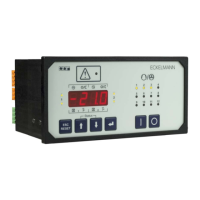
Messages/alarms are shown both as message/alarm codes on the four-digit seven-segment LED display of
VS300 integral user interface and in real language on the display of the external AL 300 Operator Terminal or
CI 3000 Store Computer when connected.
Messages/alarms in the VS 300 consist of message/alarm code, message/alarm status, date and time. On a
connected external terminal the device name, alarm priority, CAN bus address and real-language text specific to
the event are displayed together with alarm number, date and time.
Four alarm priorities are used:
- No entry in message/alarm list
0 Entered in message/alarm list without forwarding to higher-level system components
1 Entered in message/alarm list and forwarded to higher-level system components with Priority 1
(Priority 1 alarm relay operates, when installed)
2 Entered in message/alarm list and forwarded to higher-level system components with Priority 2
(Priority 2 alarm relay operates, when installed)


 To Next Page