Need help?
Do you have a question about the ECKELMANN VS 300 and is the answer not in the manual?
Outlines disclaimers for non-compliance and specifies personnel qualifications for safe operation.
Defines the intended application and details the five essential safety rules (BGV A3).
Provides guidelines for handling ESDs to prevent damage and ensure proper function.
Highlights new functionalities and improvements introduced in recent versions of the VS 300.
Describes how the VS 300 can be expanded with additional modules to increase its capabilities.
Details system configuration, including relay/control stage allocation and alarm output dispatching.
Covers methods for low-pressure control, including step, speed, and combined controllers, and compressor functions.
Outlines integrated monitoring features for high pressure, low pressure, compressor starts, and digital inputs.
Describes high-pressure control methods, fan operation, and related monitoring functions.
Covers initial controller startup procedures and methods for archiving operating data like run times and starts.
Essential notes for connecting the VS 300, emphasizing safety precautions and manual handling.
Details on how to physically install the VS 300 controller into a control panel, including mounting and ventilation.
Covers hardware settings, software configuration, access levels, and initial parameter loading for system startup.
Step-by-step guide on how to update the VS 300 controller's firmware, including requirements and procedures.
Provides a visual overview of all connecting terminals on the VS 300, including expansion stages and modules.
Details the specific pin assignments and their corresponding functions for power supply, digital inputs, and relay outputs.
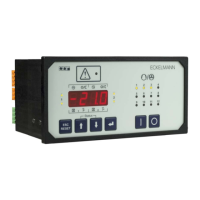
Overview of the front panel's display, status LEDs, and control buttons for operation and configuration.
Explains the navigation and organization of menus and screens for operating the VS 300.
Provides general guidelines for setting parameters via the controller's interface or external terminals.
Describes how to access and select different parameter lists for configuration and monitoring.
Details how to change user access levels to enable parameter modification and system configuration.
Explains how to manually control outputs and enter service mode for diagnostics and maintenance.
Covers how to access and interpret system and process fault reports and messages.
Details how to operate the VS 300 remotely using system centres, store computers, or operator terminals.
Introduces the various parameter lists (A, S1-S5, t, C, F) used for configuring and operating the VS 300.
Details setpoints for day/night operation, basic parameters, system configuration, and alarm priorities.
Lists and explains system and process fault reports, including message codes and status.
Provides a visual overview of the menu navigation for external terminals like AL 300 and CI 3000.
Instructions for safely disassembling and removing the equipment by trained personnel.
Guidelines for the proper disposal of electrical and electronic waste in accordance with regulations.
Details the composition of messages/alarms, including codes, status, date, time, and priorities.
Describes how messages and alarms are displayed on the VS 300's interface and how to interpret them.
Lists and categorizes different types of messages and alarms, including process and system fault reports.
Provides a detailed list of system fault codes, their display text, and the corresponding system fault report.
Lists process fault codes, their display text, and the associated system fault reports.
Details the electrical characteristics, including power supply, inputs, outputs, and voltage ratings.
Provides mechanical specifications such as dimensions, enclosure type, and installation cutouts.
Lists the available VS 300 compact pack controller models with their specifications and order numbers.
Lists essential components and accessories for the VS 300, including pressure transmitters and adapters.
 General
| Model | VS 300 |
|---|---|
| Analog Inputs | 4 |
| Analog Outputs | 2 |
| Operating Voltage | 24 V DC |
| Type | Controller |
| Communication Interface | RS-485 |
| Operating Temperature | 0°C to 50°C |

 To Next Page