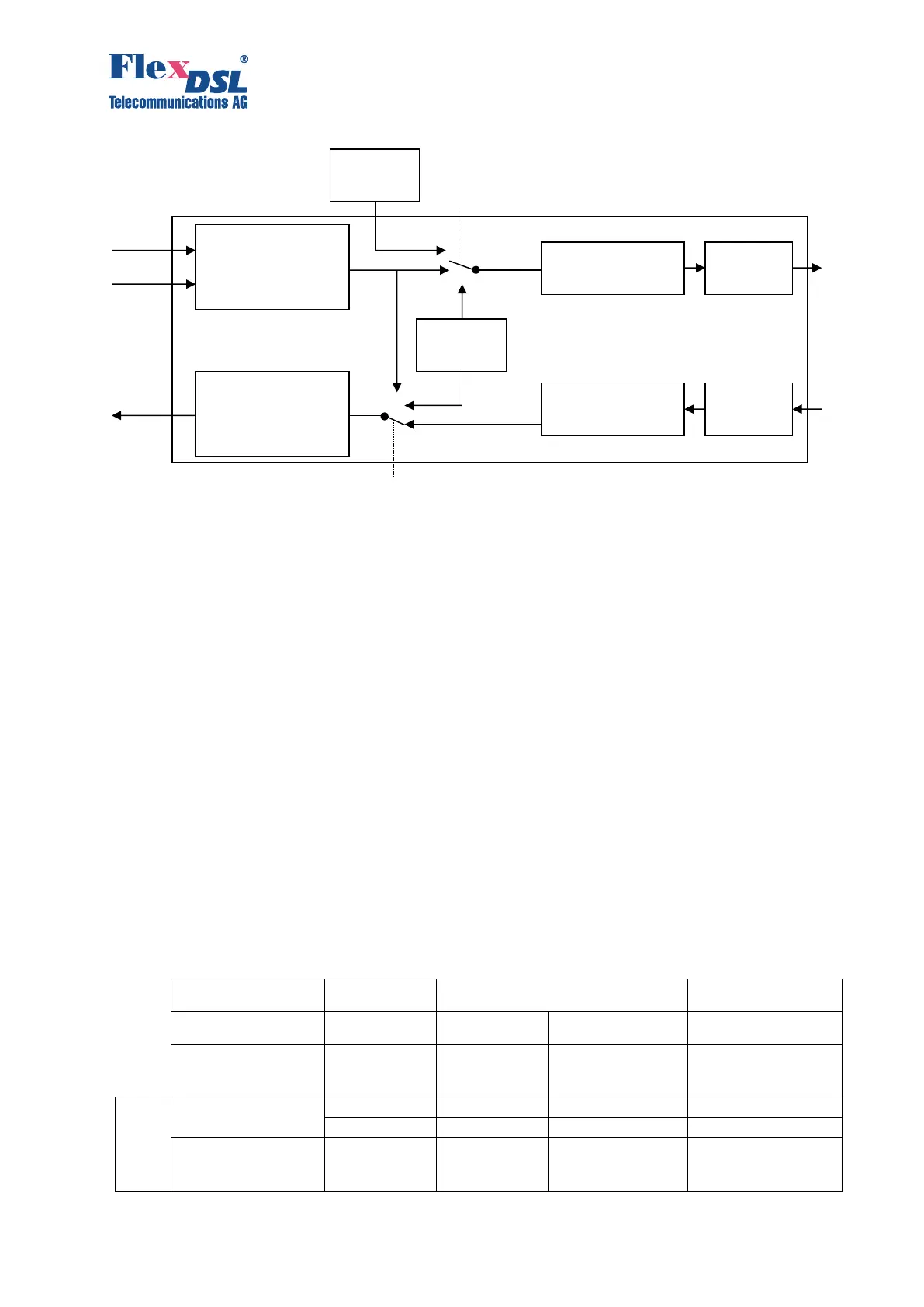
Figure 3.10. G.703/E0 clock modes
3.2.2.3.1 Nx64 Clocking Modes
Nx64 clocking modes can be selected by using the command EXTCLOCK [SRC] [DIR]. The SRC
argument sets one of 3 possible clock modes for the transmit and receive clocks (signal number
114 (TX clock) and 115 (RX Clock)):
• NORMAL (DSL) both clocks are derived from the receiving DSL stream
• INT (internal) both clocks are generated from the internal generator signal
• TTC (external) clock for signal number 115 is derived from the terminal transmit clock input
(signal number 113)
The DIR argument sets the transmit clock direction:
• CO (codirectional): Transmit clock and transmit data have same directions, i.e. both are
inputs to the modem at signal number 113 (clock) and 103 (data). In case of RX mode (see
above) the whole TX path is clocked by this clock, while in other modes data coming to TX
input (signal number 103) is put into FIFO using the clock from line 113 and get out from
FIFO by clock defined by SRC.
• CONTRA (contradirectional): Transmit clock and transmit data have opposite directions, i.e.
transmit clock is an output from the modem at signal number 114 and transmit data is an
input to the modem at signal number 103.
In combination with the command SETCLOCK (units with Nx64 interface have the possibility to
set the clock source to the SHDSL line side as Nx64 clock (parameter “V35” of SETCLOCK
command)), it is possible to realise different clock schemes. The following table shows different
valid combinations of clock modes for the Master modem:


 To Next Page