Section 5: 9500B Procedure Mode - Safety and General Notes 5.2-3
Final Width = 215mm
Descriptions assume 9500B/1100
5.2.5.4 Static RAM Card —
Non-Rechargeable Battery
Condition
Battery Voltage Monitoring
Each Static RAM card is powered by its own
battery which maintains the non-volatile status
of its RAM. While a results card is present in
PCMCIA SLOT 2, the 9500B continuously
monitors the battery voltage state. When the
voltage falls to approach a failure condition, a
warning is given on the 9500B screen.
Changing the Battery
With the card present in PCMCIA SLOT 2, the
RAM is powered from 9500B power supplies,
so it is possible to pull out the battery module
from the card and insert a new module without
losing the stored data.
5.2.5.5 Static RAM Card —
Rechargeable Battery
Battery Charging
Each Static RAM card is powered by its own
battery which maintains the non-volatile status
of its RAM. While a results card is present in
PCMCIA SLOT 2, with the 9500B powered
ON, the battery will be recharged. The specified
recharge times are 8 hours to 60% capacity,
and 40 Hours to 100% capacity. If the card
battery charge is low when the card is inserted
into PCMCIA SLOT 2, a low battery warning
may be given on the 9500B screen, during the
initial charge period of up to 40 seconds.
Battery Access and Life
The battery is not accessible to be changed in
these cards, but the retention time between
chargings is in excess of six months.
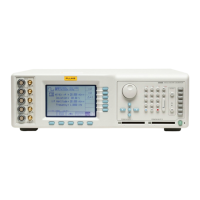
Front Panel PCMCIA Slots
In Procedure mode, the procedures for
adjustment and verification operations for
UUTs are controlled from a pre-programmed
memory card, inserted in the left PCMCIA
SLOT 1 on the 9500B front panel. The results
of these operations can be saved on Static
RAM memory cards, inserted in the right
PCMCIA SLOT 2. The 9500B 'Test' mode of
operation can be used to erase SRAM cards
containing old results, and initialize them as
blank results cards (refer to Section 8, paras
8.3.4.5).
Although 'FLASH' cards are used to store
procedures, they cannot be used for storing
results.
5.2.5.1 Results Card Enabling and
Insertion
Use of Config Mode
Config mode is used to enable results to be
saved on memory cards. Details can be found
in Section 3, paras 3.4.3.17.
Inserting the Card
Before the results can be saved, a memory card
must be inserted into PCMCIA SLOT 2 and
pressed firmly home. If a card is not present,
a reminder will be given on the screen when the
internal program attempts to write results.
Examine the Memory Card
The 68-way socket pins can be seen on the end
of the card to be inserted:
Keep this side on top
Insert this end into 9500 slot
Missing key
Missing key
underneath
Top
Socket pins this end
Insert
5.2.5 Saving Results on Memory Cards
5.2.5.3 Results Memory Space
After a 'Procedure' memory card is created, an
estimate of the results memory requirement
for each procedure is calculated and written on
to the card.
When in use, before the first results for a
procedure are written into the 'Results' card,
the 9500B system will review the free memory
space on the card. If this is less than 150% of
the procedure's estimated results requirement,
the user will be warned to insert a different
card.
Insert the Card
When inserting, the missing key must be located
underneath the card on the right front:
Write-Protect Switch
The Static RAM cards can be write-protected
by means of a small switch on the opposite end
to the contact pins. Obviously this protection
must be switched off before the 9500B can
write results. If a card is write protected, a
warning message will appear on the screen.
Do Not Remove in Mid-Procedure
It is not necessary to insert a card before
enabling, but once the card is inserted, it must
not be removed until the procedure is ended or
aborted. Such removal will corrupt data.
5.2.5.2 Stage-by-Stage Results
Saving
The 9500B internal program will generate and
save results at the conclusion of each stage in
the UUT adjustment or verification procedure.
The end of each stage is marked by the use of
the 'OK', 'PASS' or 'FAIL' screen key on the
front panel (or, of course, by the equivalent use
of the tracker unit buttons).


 To Next Page