9-30 Section 9: Verifying the Model 9500B Accuracy Specification
Final Width = 215mm
9.9.3.5 Verification Measurement Procedure
1. Copy the Table 9.9.3.1.
2. Using Table 9.9.3.1, follow the correct sequence of verification
points as shown on the table, and carry out operations (3) to (8) at
the verification points on the table.
3. 9500B For the verification point:
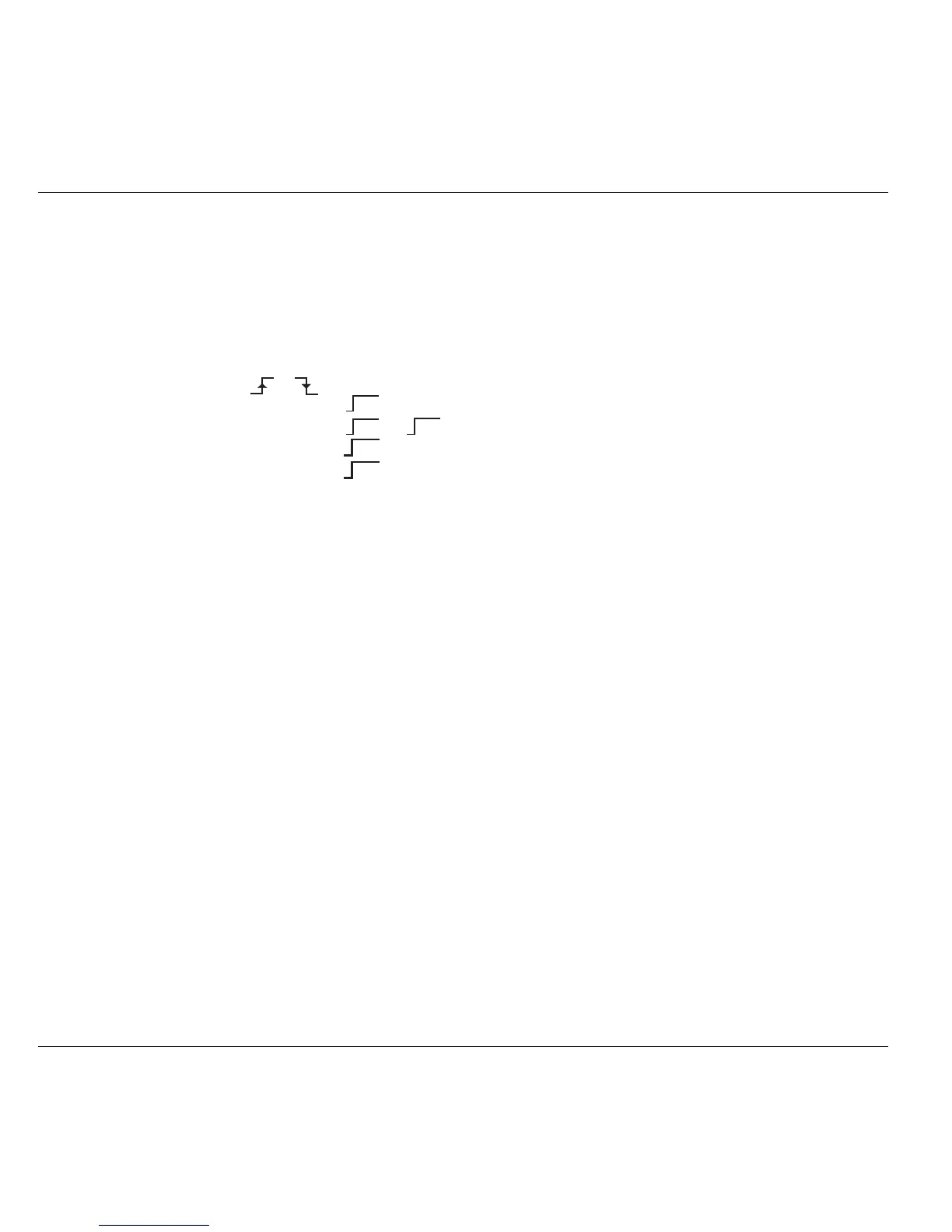
Select: Edge type:
or
Rise time for Model 9510:
500ps
only
for Model 9530:
500ps
or
150ps
for Model 9560:
for Model 9550:
Scope mode or Numeric entry
Set: O/P Amplitude p-p
O/P Frequency/Period
4. Oscilloscope a. Select the correct channel.
b. Select the correct sweep speed, trigger level,
trigger edge and channel sensitivity to measure
at the verification point.
5. 9500B Set Output ON.
6. Oscilloscope a. Adjust the sweep speed and trigger level for a
stable display.
b. Check the waveform for correct polarity ('Rise'
selected: from a negative potential to ground;
'Fall' selected: from a positive potential to
ground).
7. Rise Time a. Measure the (10% to 90%) combined pulse
rise/fall time.
b. Calculate the Edge function rise/fall time:
Edge Function Rise/fall time =
√(Observed Rise Time
2
- Scope Pulse Response Time
2
) ps
c. Record the Measured Edge function rise/fall
time on the copy of the Table.
d. Record the 9500B displayed Rise Time on the
copy of the Table.
8. 9500B Set Output OFF.
9.9.3.6 Calculation of Validity Tolerances
1. Introduction
The first part of the verification procedure in sub-section 9.9.3.5 deals
with measurement of rise/fall times, into an input impedance of 50Ω.
Each rise/fall time is measured on a wide-bandwidth oscilloscope,
whose pulse response time is taken into account.
To calculate the validity tolerance limits at each verification point, we
must take into account the User's Total Measurement Uncertainty and
the specified 9500B Speed Tolerance. These are combined using an
RSS calculation.
2. Example: Calculation of Validity Tolerance (500ps at 25mV)
• From the Oscilloscope Specification, let us say that its Total
Measurement Uncertainty (500ps at 25mV), is: ±20ps.
• With this we must combine (by RSS Method) the 9500B Speed
Tolerance specification. At 500ps, the 9500B specification speed
tolerance is +50ps to -150ps.
• Considering the upper limit:
Validity Tolerance = √[(20ps)
2
+ (50ps)
2
]
= 53.85ps
• We must now add this Validity Tolerance to the Nominal value of
500ps, giving the Upper Validity Tolerance Limit of 553.85ps.
• Considering the lower limit:
Validity Tolerance = √[(20ps)
2
+ (150ps)
2
]
= 151.32ps
• We must now subtract this Validity Tolerance from the Nominal
value of 500ps, giving the Lower Validity Tolerance Limit of
348.68ps.
9.9.3.7 Calculation of Validity Tolerance Limits and
Edge Speed Check
a. Calculate the User's Total Measurement
Uncertainty and Validity Tolerance Limits,
and enter in the appropriate columns of the
copy of the Table. For further assistance, refer
to sub-section 9.9.3.6
b. Check that the Measured Value is at or between
the Upper and Lower Validity Tolerance Limits.
c. Check that the difference between the '9500B
Displayed Value' [recorded at para 9.9.3.5
operation 7(d)] and the 'Measured Value'
[recorded at para 9.9.3.5 operation 7(c)] is
within the 9500B displayed value accuracy
specification of the Measured Value (see note
† below the table).
70ps
25ps


 To Next Page