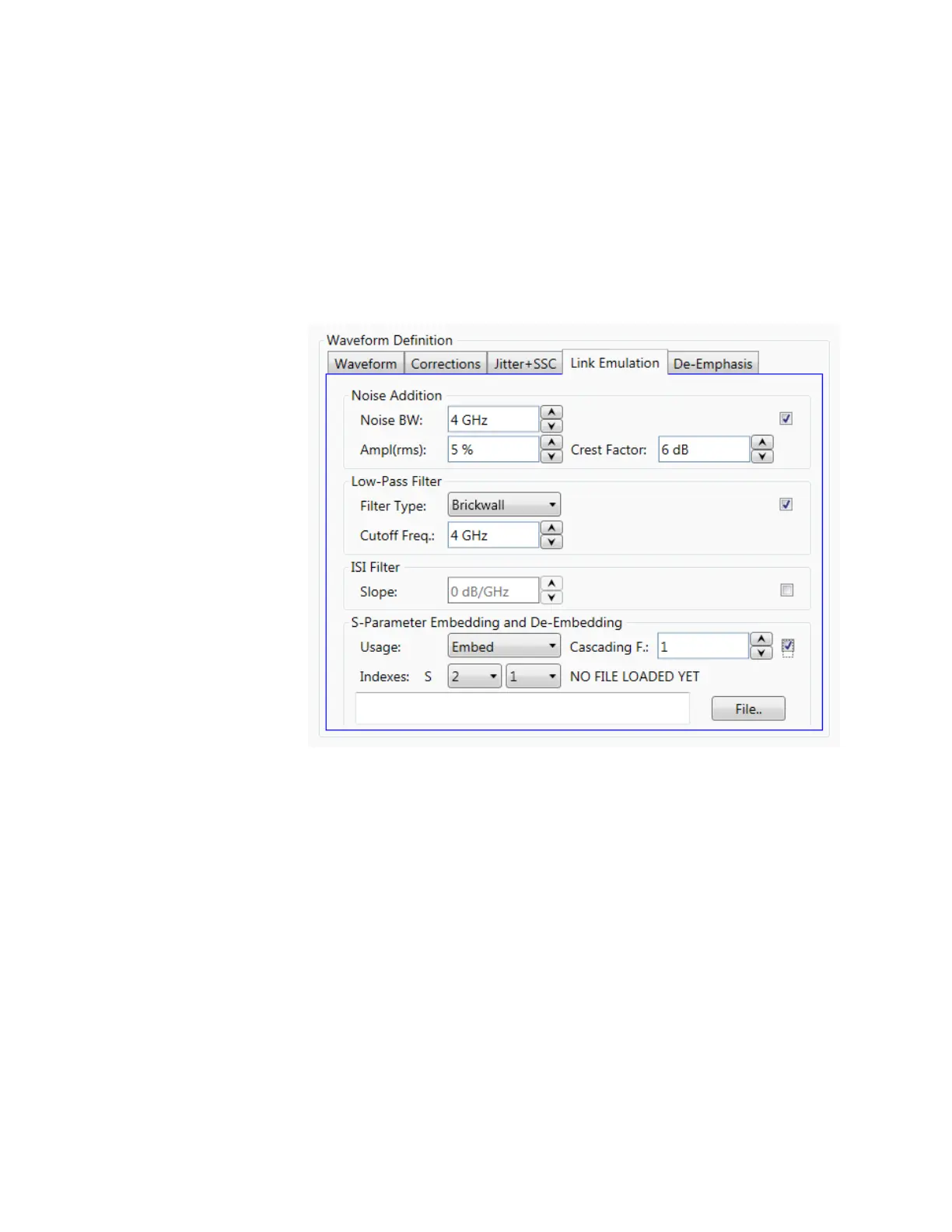
Link Emulation Tab:
In this tab, linear distortions and noise can be added to the waveforms to emulate the
physical effects of interconnections and crosstalk. In addition to standard low-pass
filters whose parameters can be set by the user, it is possible to import Touchstone files
to embed or de-embed S-parameter responses obtained through frequency-domain or
time-domain analysis instruments or directly synthesized by simulation tools. Each
section in the tab can be independently enabled by checking the checkbox located at
the top right corner of each section. Every corresponding checkbox must be checked to
edit the parameters in each section and to activate their effects in the waveform being
generated.
Noise Addition Section: Bandwidth-limited Additive White Gaussian Noise (AWGN) can
be added to the waveform to emulate a plurality of interfering noise sources. Noise is
always added to the waveform before applying any linear distortion found in this tab (so
it will behave as a “near-end” noise). Although the PDF (probability distribution
function) of the AWGN noise follows accurately the Gaussian distribution, the
corresponding profile is implemented by adding the noise to the synthesized waveform,
so the same noise will be repeated if the waveform is generated continuously by looping
the same segment. As a result, the statistical quality of the jitter distribution will
improve with longer waveform lengths. The following controls are available:
Noise BW: Bandwidth for the Gaussian noise can be set in Hertz (Hz).
Ampl(rms): Root-mean-square amplitude for noise is set as a percentage of
the reference “low” to “high” excursion. Reference “low” and “high” amplitudes
correspond to the final, steady level after a long run of consecutive “low” or
“high” states. These levels are not influenced by any low-pass or de-emphasis
filters applied to the waveform (see Figure 22), so it is used to establish an
absolute reference for relative amplitudes.
Crest Factor: This parameter is expressed in dB relative to the rms amplitude
of the noise. If the combined waveform (signal + noise) goes beyond the valid
lower and upper limits, samples are clipped to the corresponding limit. The



 To Next Page