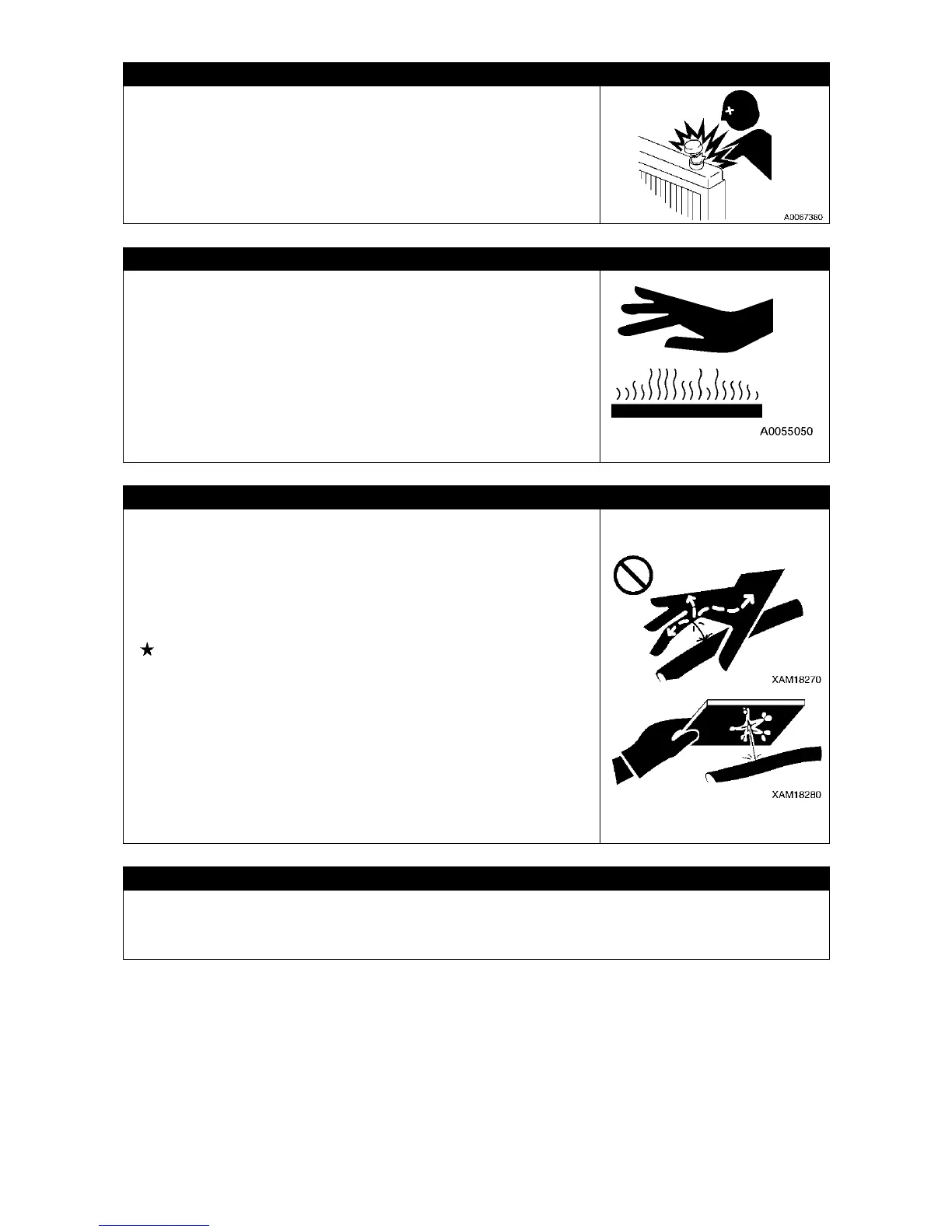
CAUTIONS WHEN COOLANT TEMPERATURE IS HIGH
To prevent burns from hot water or steam spurting out when checking
or draining the coolant, wait for the water to cool to a temperature
where it is possible to touch the radiator cap by hand before starting
the operation. Even when the coolant has cooled down, loosen the
cap slowly to relieve the pressure inside the radiator before removing
the cap.
CAUTIONS WHEN OIL TEMPERATURE IS HIGH
To prevent burns from hot oil spurting out when checking or draining
the oil, wait for the oil to cool to a temperature where it is possible to
touch the cap or plug by hand before starting the operation. Even
when the oil has cooled down, loosen the cap or plug slowly to relieve
the internal pressure before removing the cap or plug.
CAUTIONS FOR HIGH PRESSURE OIL
The hydraulic system is always under internal pressure. When
inspecting or replacing piping or hoses, always check that the
pressure in the hydraulic circuit has been released. If the circuit is still
under pressure, it will lead to serious injury, so always do as follows.
• Release the pressure in the hydraulic circuit. Do not carry out any
inspection or replacement work when the hydraulic system is under
pressure.
Refer to "Maintenance 12. Releasing the Internal Pressure from
the Hydraulic System".
• If there is any leakage from the piping or hoses, the surrounding
area will be wet, so check for cracks in the piping and hoses and for
swelling in the hoses.
When carry out inspection, wear safety glasses and leather gloves.
• There is a hazard that high-pressure oil leaking from small holes
may penetrate your skin or cause blindness if it contacts your eyes
directly. If you are hit by a jet of high-pressure oil and suffer injury to
your skin or eyes, wash the place with clean water, and consult a
doctor immediately for medical attention.
CAUTIONS FOR HIGH PRESSURE FUEL
High pressure is generated inside the engine fuel piping when the engine is running. When carrying out
inspection or maintenance of the fuel piping system, wait for at least 30 seconds after stopping the
engine to let the internal pressure go down before starting inspection or maintenance.



 To Next Page