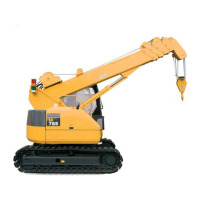
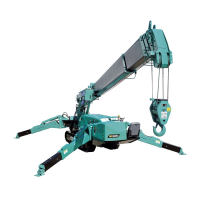
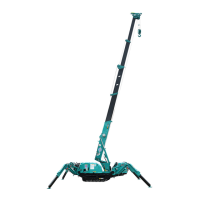
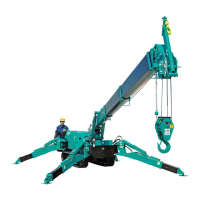
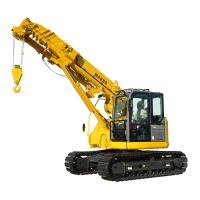
When transporting the machine on a trailer, do as follows.
• The weight, transportation height, and overall length of the machine differ accroding to the crane.
• When passing over bridges or structure on private land, check first that the structure is strong enough
to support the weight of the machine.
• When traveling on public roads, check first with the relevant authorities and follow their instructions.
• For details of the transportation procedure, see “Operation 6. Transportation”.
When loading or unloading the machine, mistaken operation may
bring the hazard of the machine tipping over or falling, so particular
care is necessary. Always do as follows.
• Select a location that is level and has firm road surface when
loading or unloading the Machine. In addition, keep enough
distance from the roadside.
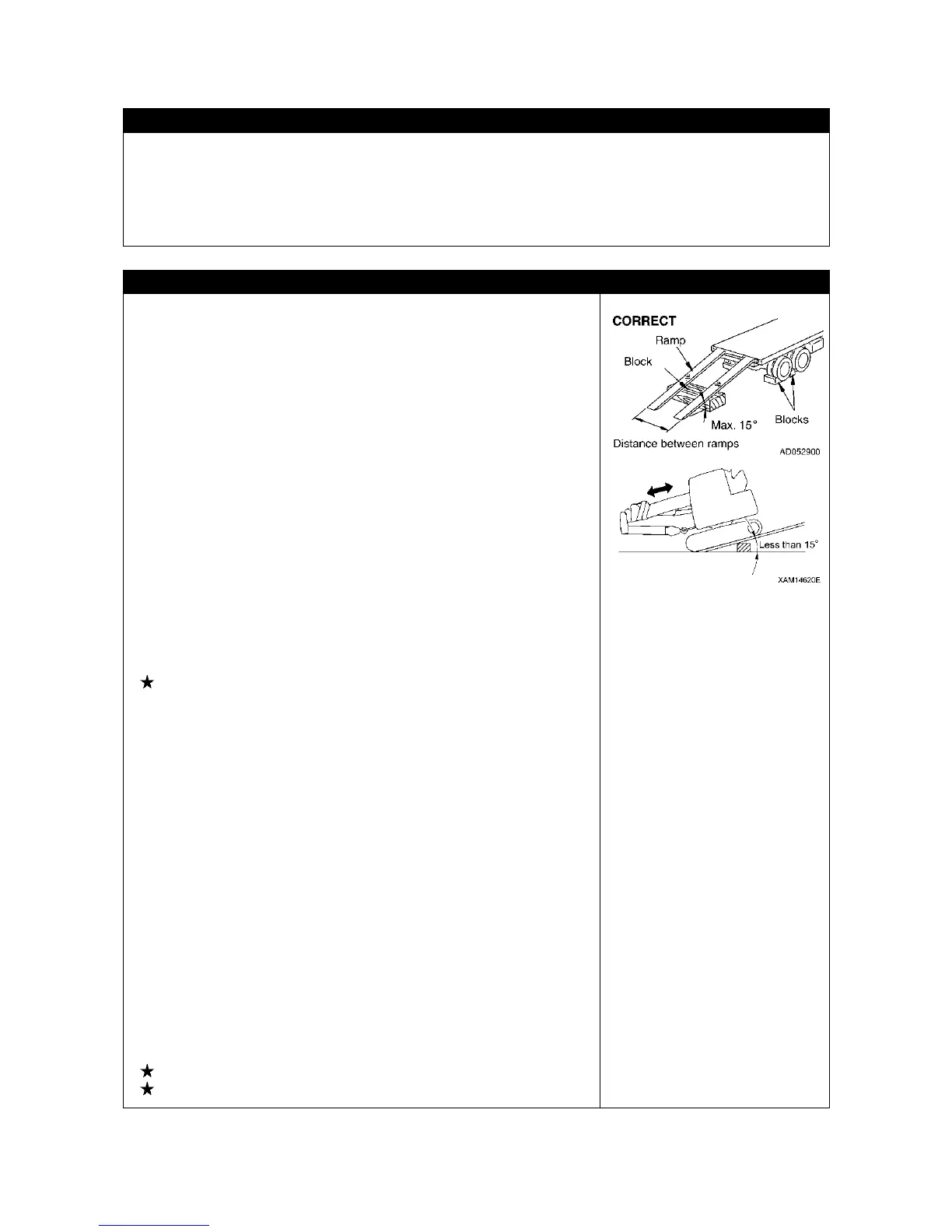
• Use the ramps under 15 degrees or smaller angle. In addition,
decide the clearance between ramps to meet the center of the
tracks.
• Use the ramps that have fully strong width, length and thickness,
and that enable safe loading/unloading. Reinforce with blocks or
other substances if the ramps deflect much.
• Remove the mud and other substances from the footing to prevent
the Machine from skidding over the ramps. Remove the substances
stuck the ramps such as grease, oil or ice, and keep clean.
Be especially careful in the rainy days where slips easily occur.
• Always turn the auto-deceleration switch OFF (cancel).
If the auto-deceleration switch is left ON, the machine may suddenly
move.
• When loading or unloading the machine, always keep it in a
traveling posture and fix the hook block by the stowage wire rope.
See “Operation 3.7 Machine Travel Posture” for details.
• When loading or unloading, set the engine rotation to low idling (low
speed rotation) and operate slowly by low speed travels.
• Always move backward when loading the Machine. Moving forward
may cause a trip.
• When on the ramps, do not operate any lever except for the travel
lever.
• Never correct your steering on the ramps. If necessary, drive off the
ramps, correct the direction, and then enter the ramps again.
• The center of gravity of the machine will change suddenly at the
point between the ramps and the truck or trailer, and there is danger
of the machine losing its balance. Travel slowly over this point.
• When loading or unloading to an embankment or platform, make
sure that it has suitable width, strength, and grade.
• When the machine is required to turn its direction on the carrier,
keep it in a traveling posture and operate slowly, as the base is
unstable.
• Always lock the door after loading machine. If this is not done, the
door may suddenly open during transportation.
• After loading the machine, apply the wood blocks so that the
machine does not move, and securely fix with wire ropes or other
means.
See “Operation 6.1 Loading/unloading” for details.
See “Operation 6.3 Cautions in Loading Machine” for details.



 To Next Page