3-169
4. HANDLING WIRE ROPES
4.1 BENCHMARK FOR REPLACING WIRE ROPES
• The benchmark for replacing wire ropes is common to all the wire ropes for winching,
telescoping the boom, and slinging.
• Measure the wire rope diameter at the section where the rope repeatedly passes through the
sheave. Measure from three directions and average the value.
• Do not use old wire ropes even if they had not been used.
• See “Maintenance 8.5 [2] Replacement Winch Wire Ropes” for how to replace the wire rope.
• Contact us or our sales service agency for replacing/repairing the wire ropes.
[1] WIRE ROPE NOMINAL DIMENSION
• Wire rope for winching : IWRC 6 x Ws (29) 0/0 φ10 x115 m
• No. 5 wire rope for extending boom: IWRC 6 x Fi (29) 0/0 φ10
• No. 5 wire rope for retracting boom: IWRC 6 x Fi (29) 0/0 φ8
[2] BENCHMARK FOR REPLACING WIRE ROPES
The wire rope fatigues as time goes by.
Change the wire ropes when they show the following signs.
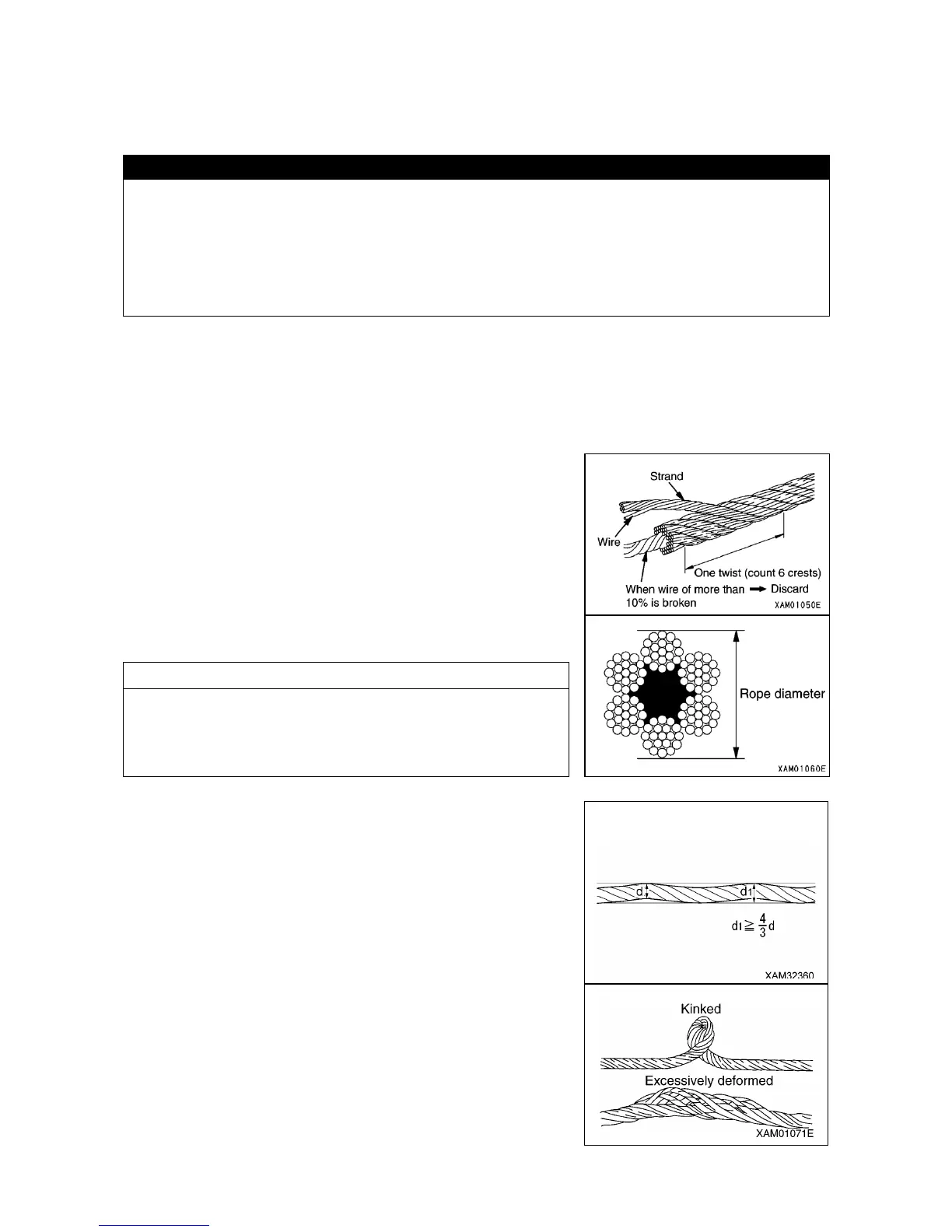
1. Percentage of the snipped wires in total wires (except filler
wires) in outer strands exceeds the ratio below:
(1) 10% or more of the wires in one twist of the wire rope, or 5%
or more when such nipped wires are in one single strand..
(2) 20% or more of the wires in five twists of the wire rope.
2. The diameter of the wire rope is worn for 7 % or more of the
nominal diameter.
• Change the 10-mm diameter wire rope when it is reduced to 9.4
mm.
• Change the 8 mm diameter wire rope when it is reduced to 7.5
mm.
3. The wire rope, corroded as below:
(1) Wire surface has pitching and pitting.
(2) Wires become slack due to internal corrosion.
4. Excessively deformed as below:
(1) The rope is twisted and has some kinks.
(2) Waviness width is 4/3d or more in a distance within 25 times
of nominal diameter d.
(3) The minimum diameter is 2/3 or less of the maximum
diameter due to local pressure and being flattened.
(4) Core wire or wire core projects.
(5) Excessively curved.
(6) Basket-like deformation.
(7) A strand sinks inside.
(8) One strand or more is slacked.
(9) Wires project excessively.
5. The rope shows some abnormality at the terminals.



 To Next Page