13. Residual current device (RCD) testing
WARNING : RCD tests are live circuit tests and all precautions for live working must be followed.
13.1 General
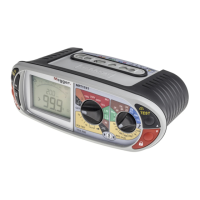
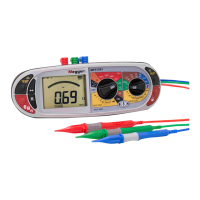
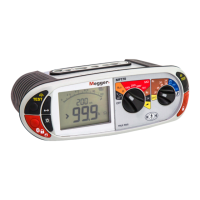
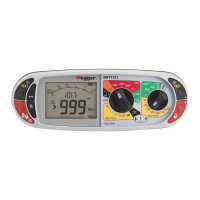
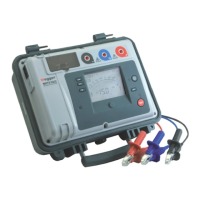
The MFT-X1 can measure the tripping time and tripping current for a wide range of residual current device (RCD) and
Residual Direct Current-Disconnection Device (RDC-DD) types with sensitivity from 10 mA to 1000 mA.
RDC-DD is shortened to RDC in the MFT-X1.
Tests carried out by the instrument comply with IEC 61557 Part 6 for RCDs and IEC62955 for RDC-DDs
Test options include trip time testing, trip current testing and combined or separate touch voltage testing, also
referred to as fault voltage testing.
The instrument also offers a unique user-configurable automatic test sequence that includes some or all these tests,
as well as ramp tests that are useful for investigating nuisance tripping.
13.1.1 Types of RCD supported
The MFT-X1 can test these types of RCD:
AC – ensures disconnection for AC residual currents only
A – ensures disconnection for AC and pulsed DC residual currents
F – should be tested as type A, but is sensitive to higher frequency earth faults
B – ensures disconnection for AC, pulsed DC and smooth DC residual currents
EV (RDC-DD) – ensures disconnection for pure DC residual currents of up to 10 seconds duration
(S) – Delayed versions of RCDs
NOTE : An RDC is a Residual Direct Current detecting device found in EV charger systems that typically
operates at less than 6mA in a time of not greater than 10 seconds.
NOTE : A type S version of an RCD have a delayed trip on detection of a leakage current of 150 ms.
This is intended for use where there is a requirement for discrimination between RCDs in a protection
installation. Testing a type S version starts a 30 second count-down timer before applying the tripping
tests. This is required to ensure the internal 150 ms delay is not compromised by the touch voltage test at
the start of all RCD tests. This touch voltage test is not visible to the user but could affect the 150 ms delay
enough to create a faster trip time than normal, potentially failing the RCD.
NOTE : RCBOs (residual current breakers with overcurrent protection) can be tested in the same way as
RCDs, but only the residual current protection function provided by these devices is tested, not the
over-current protection.
13.1.2 RCD test current
When testing RCDs or an RDC, you should select the test current that matches the nominal rating of the device under
test. For example, for a 30 mA RCD, select a test current of 30 mA on the instrument followed by the multiplier you
need, e.g. 1/2 x I, 1 x I, 2 x I or 5 x I.
The MFT-X1 has a limit of 1000 mA for any test selected. With some higher current RCDs and especially type A or
type B RCD, the range of tests that you can carry out is restricted. For example, the MFT-X1 cannot perform 5 x I
tests on RCDs with a 300 mA rating or higher, as this would require a test current of 5 x I or 5 x 300 mA = 1500
mA, exceeding the 1000 mA limit. The diagram below shows which combinations of RCD type and test current are
supported, and which are not. If you try to select an unsupported combination, this diagram is shown automatically
on the instrument display as a reminder.
www.megger.com
MFT-X1
50
Residual current device (RCD) testing



 To Next Page