PAGE 1-11118824, VER. 00
CHAPTER 1: INTRODUCTION
1.0 PRODUCT OVERVIEW
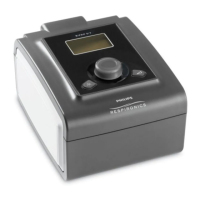
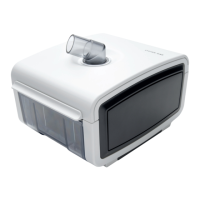
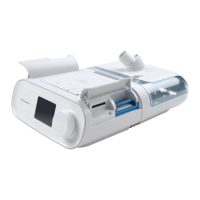
The BiPAP AVAPS and BiPAP S/T devices are intended to provide noninvasive ventilatory (NIV) support to
treat adult patients weighing over 30 kg (66 lbs) and pediatric patients 7 years or older and weighing over 18 kg
(40 lbs) with Obstructive Sleep Apnea (OSA) and Respiratory Insufficiency. These devices may be used in the
hospital or home.
1.0.1 BIPAP AVAPS & BIPAP S/T
The BiPAP AVAPS responds reliably to patient flow rates that indicate movement to inhalation or exhalation,
even in the presence of most normal leaks in the patient circuit. Automatic adjustment of this trigger threshold
in the presence of leaks makes the system ideal for mask-applied ventilation assistance. The patient
controllable Rise Time and Bi-Flex features may enhance patient-ventilator AVAPS and patient comfort.
The BiPAP AVAPS operates in the following modes: Continuous Positive Airway Pressure (CPAP),
Spontaneous (S), Spontaneous/Timed (S/T), Timed (T), and Pressure Control (PC). In the Continuous Positive
Airway Pressure (CPAP) mode, the BiPAP AVAPS delivers continuous pressure support ventilation at one
pressure level. The BiPAP S/T operates in CPAP, S and S/T modes.
In the Spontaneous (S) mode, bi-level pressure support is delivered. The device triggers to Inspiratory Positive
Airway Pressure (IPAP) in response to spontaneous inspiratory effort and cycles to Expiratory Positive Airway
Pressure (EPAP) during exhalation. The level of pressure support delivered is determined by the difference
between the IPAP and EPAP settings.
The Spontaneous/Timed (S/T) mode is similar to the S mode, except that it also can deliver a machine-
triggered breath if the patient does not spontaneously breathe within a set time. The S/T mode ensures that
patients receive a minimum number of breaths per minute based on the Rate setting. If the patient fails to
initiate an inspiration within the interval determined by the Rate control, the unit triggers a timed (or machine-
triggered) breath resulting in a pressure-control (pressure-limited, time-cycled) breath at the set IPAP level.
The rate of timed breaths is adjustable. The duration of each timed breath is controlled by an Inspiratory Time
control.
The Timed mode provides mandatory pressure assist. All breaths are machine triggered and machine cycled.
The patient breathing has no affect on this machine. The triggering is determined by the Breath Rate control.
The cycle time is determined by the Inspiratory Control.
The PC mode is equivalent to the S/T mode except that all breaths are machine cycled and, therefore, have a
fixed inspiratory time. This mode is a pressure limited, machine or patient triggered, time cycled mode. The
patient may initiate a breath, but all breaths are pressure limited (IPAP) and time-cycled. The cycle time is
determined by the Inspiratory Time control setting.
AVAPS is available in the S, S/T, Timed, and PC modes. AVAPS provides dynamic IPAP control. The IPAP
pressure is dynamically controlled so that exhaled tidal volumes approach the V
te
control value. AVAPS
provides gradual pressure changes to compensate for the tidal volume error observed over several preceding
breaths.
CAUTION
U.S. federal law restricts this device to sale by or on
the order of a physician.





 To Next Page
