123
Polyend Tracker Manual
122
Polyend Tracker Manual
NOTESNOTES
Wavetable Parameters
The wavetable play mode is a simplied application of wavetable synthesis
and consists of two core parameters. The Window is the wavetable length
(samples per frame) and has a maximum value based on the original le.
The position parameter is what enables the creative sound design and
audio manipulation. This can be manually adjusted to nd a sweet spot or
modulated with the envelope or LFO.
Instruments
6
Instruments
6
6.10 Wavetable Play Modes
Wavetable instruments can be created in Tracker. This emulates classic
wavetable synthesizers by using a sample as the wavetable source.
Standard Tracker samples can be used ‘out of the box’ or samples
prepared specically to suit the application in a wavetable synth and give
better performance. While Tracker offers only a basic implementation of
wavetable synthesis it does bring a different creative option into the
instrument library.
What is Wavetable Synthesis?
The most common synth model is subtractive synthesis. This is based on a
sound source, typically using one or more oscillators, tuned in various
ways. The sound is then shaped and carved by ltering out (subtracting)
frequencies, applying envelopes and adding effects. Wavetable synths
typically follow these same principles but the ‘oscillator’ is formed from a
series of wave-shapes called wavetables. In reality, a wavetable consists of
a number of stacked samples called frames, the accepted standard being
256 frames.
Navigating or modulating through the almost endless wave positions and
selecting ‘single cycles’ in the wavetable is a fundamental element in
wavetable sound design. In Tracker the wavetable size (samples per frame)
is set by the ‘Window’ parameter. Think of this as the length of the available
table, the default maximum being dened by the original audio sample
format. The specic ‘Position’ within the wavetable is also selectable and
important in the sound design process. Position can also be modulated.
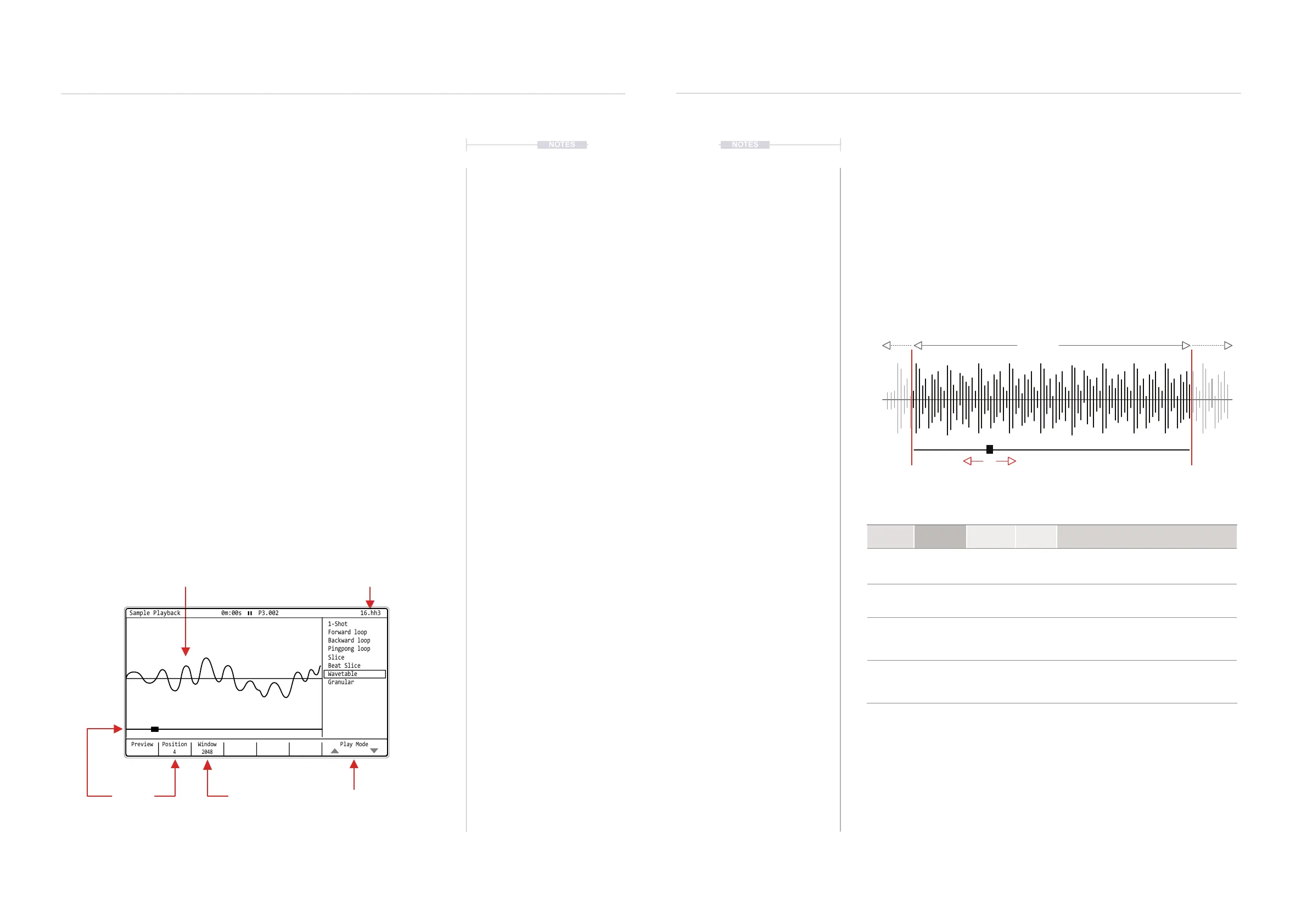
Current Instrument
Selected
Sample
Waveform Cycle.
Play Mode List.
How the sample will be
played in the instrument
Window
Frame size, range dictated
by wavetable format
Position
Wave position selection,
also can be modulated.
Preview Position
4
Window
2048
Play Mode
Sample Playback 0m:00s P3.002
1-Shot
Slice
Forward loop
Beat Slice
Backward loop
Wavetable
Pingpong loop
Granular
16.hh3
Position
Size of window will affect resolution
Window
Function Parameter
Screen
Button
Range Description
Edit Play Mode 7th & 8th
Modes
Selects the play mode to apply. Includes
Wavetable and Granular as well as 1-Shot and the
three loop modes.
Aid Preview 1st
Hold to play the wave from the current position
selected in the window. Also hold while adjusting
position to ‘scan’ for the desired sound.
Aid Window 3rd
Variable
The width of the wavetable can be adjusted down
from the default maximum. The parameters are
normally divisions of 2 down from the maximum
(Typically 2048)
Edit Position 2nd
Variable
Selects the playback position within the wavetable
window. This can be manually adjusted to nd the
desired ‘sweet spot’ or modulated with an LFO or
Envelope for movement and interest.


 To Next Page