Date Code 20001006 Testing and Troubleshooting 13-5
SEL-351 Instruction Manual
The examples below show the settings necessary to route the phase time-overcurrent element
51PT to the output contacts and the SER. The 51PT element, like many in the SEL-351 Relay, is
controlled by enable settings and/or torque control SELOGIC
®
Control Equations. To enable the
51PT element, set the E51P enable setting and 51PTC torque control settings to the following:
• E51P = 1 (via the SET command)
• 51PTC = 1 (set directly to logical 1, via the SET L command)
Testing Via Front-Panel Indicators
Display the state of relay elements, inputs, and outputs using the front-panel or serial port TAR
commands. Use this method to verify the pickup settings of protection elements.
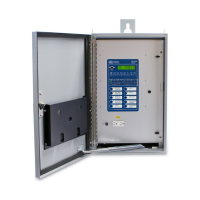
Access the front-panel TAR command from the front-panel OTHER pushbutton menu. To
display the state of the 51PT element on the front-panel display, press the OTHER pushbutton,
cursor to the TAR option, and press SELECT. Press the up arrow pushbutton until TAR 6 is
displayed on the top row of the LCD. The bottom row of the LCD displays all elements asserted
in Relay Word Row 6. The relay maps the state of the elements in Relay Word Row 6 on the
bottom row of LEDs. The 51PT element state is reflected on the LED labeled RS. See Table 9.3
for the correspondence between the Relay Word elements and the TAR command.
To view the 51PT element status from the serial port, issue the TAR 51PT command. The relay
will display the state of all elements in the Relay Word row containing the 51PT element.
Review TAR command descriptions in Section 10: Serial Port Communications and
Commands and Section 11: Front-Panel Interface for further details on displaying element
status via the TAR commands.
Testing Via Output Contacts
You can set the relay to operate an output contact for testing a single element. Use the SET L
command (SELOGIC Control Equations) to set an output contact (e.g., OUT1 through OUT11 for
Model 0351xT) to the element under test. The available elements are the Relay Word bits
referenced in Table 9.3.
Use this method especially for time testing time-overcurrent elements. For example, to test the
phase time-overcurrent element 51PT via output contact OUT4, make the following setting:
OUT4 = 51PT
Time-overcurrent curve and time-dial information can be found in Section 9: Setting the Relay.
Do not forget to reenter the correct relay settings when you are finished testing and ready to
place the relay in service.
Testing Via Sequential Events Recorder
You can set the relay to generate an entry in the Sequential Events Recorder (SER) for testing relay
elements. Use the SET R command to include the element(s) under test in any of the SER trigger
lists (SER1 through SER3). See Section 12: Standard Event Reports, Sag/Swell/Interruption
Report, and SER.
Courtesy of NationalSwitchgear.com


 To Next Page