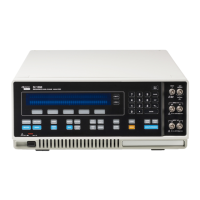
1250 Frequency Response Analyzer The RS423 and GPIB Ports. Remote Control
AMK/1250/4 13-19
COMMANDS IN ALPHABETICAL ORDER (Continued)
Code Meaning
*B Edit Previous Line
*C Clear Program
*D Edit by Deleting Line
*E Enter Program Edit Mode
*F Edit Next Line
*I Edit Insert Mode
*L Enter Program Learn Mode
*P List Program
*Q Exit from Learn/Edit Mode
13.8 GPIB CONTROLLER: LANGUAGE USED IN PROGRAM
EXAMPLES
To clarify the use of the GPIB port for remote control of the 1250, several examples are
given of GPIB Controller programs. Each example is written as a series of abbreviated
commands, including some BASIC programming language instructions. The programs
are representational only and are not suitable for directly programming a Controller.
The examples are intended to show the required sequence of events, as they affect the
controls of the 1250. Other GPIB commands, such as Enable Signals and Addressing,
are omitted. The most commonly used instructions are listed below, with a full
explanation of their meaning.
Instruction Meaning
OUTPUT " “ Send to the 1250 the string of characters within inverted
commas, plus a Command Terminator.
INPUT Receive data from the 1250
INPUT A Receive data from the 1250 and store it in Location A.
PRINT Print the statement:
"FREQUENCY = ", A Frequency = "the value stored in location A"
DIM A$ (100) The Controller is instructed to allocate sufficient temporary
store space to accommodate a maximum of 100 strings of
characters. A string could consist of a Learnt Program
Command, a stored reading from the File etc. The store
area is given the name A$.
FOR I = 1 to N This is a loop instruction telling the Controller to store each
INPUT A$ (I) line of the 1250's output in area A$, from Line 1 to the final
NEXT I Line N. The loop instruction terminates when I = N.
13.9 COMMAND QUERY
This feature may be used to examine the state or value of any parameter in the 1250.
The format of the Command is:
? XYn
where XY is the two-letter Command Code, e.g. FR for frequency, and n is a number
specifying which parameter is required in Commands having more than one Argument,
e.g. ?TM0 will give the "hours" value of Time, and ?TM1 will give the "minutes" value.
Note: if not specified, n defaults to zero.



 To Next Page