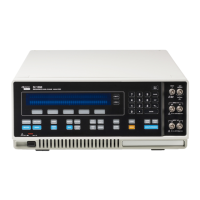
Making Measurements: The Analyzers 1250 Frequency Response Analyzer
5-6 AMK/1250/3
With auto-integration. Not all the steps in the sweep will need the full 10 seconds. A
typical simplified allocation could be:
20 points at 10 seconds each = 200 seconds
15 points at 5 seconds each = 75 seconds
25 points at 1 second each = 25 seconds
TOTAL 300 seconds = 5 minutes
i.e. half the previous time.
5.3 SETTING INDIVIDUAL ANALYZERS
Having completed the setting up of the common features of the Analyzers, the last
operation of the ENTER key should have left the Display showing [ANALYZER
COMMON). Successive operations of the SELECT key will call up the specific Analyzer
menus, each of which will assign four soft keys as follows:
5.3.1 RANGE
Pressing this key offers the user a choice of several fixed ranges from 30mV to 300V.
See the full Specification, Chapter 17 for details of these.
There is also an auto-ranging feature whereby the 1250 itself selects the range which
will produce an accurate result with the best possible resolution. Measurements start on
the most sensitive range and as soon as an overload is detected, the measurement is
terminated, the range is changed and the measurement restarted. This process
continues until the correct range has been found.
On termination of the measurement, the Analyzer automatically resets to the most
sensitive range, so if on Recycle, the auto-ranging process is repeated for every
measurement. The default state is auto-range.
5.3.2 DEMOD
This key is used only when the optional Modulator/Demodulator Unit is fitted.
Instructions for its use will be found in Chapter 15, Options. The default state is off. The
Unit is not required for simple measurements.
If an attempt is made to enter any state other than off via the DEMOD key, when no
Unit is present, an Error Code Number will appear in the Display, accompanied by a
warning "beep". The Error Codes are listed in Chapter 11.
5.3.3 COUPLING
The default state gives direct [dc] coupling of the signal to the Analyzer input. This
mode should be used wherever possible, as it introduces minimum phase shift,
particularly at low frequencies.
On the other hand, if the incoming signal has an unwanted direct component, such as dc
bias, this could necessitate using the Analyzer on a relatively insensitive range, which
would impair the resolution of the ac component. In this case, ac coupling may he used
to block the dc component.
5.3.4 INPUT
On 1250A, 1250N, the Analyzer input can be routed via the 4mm sockets on either the
front or rear; this is selectable via the front panel or a remote command code. The
default is Front. For 1250B and 1250E, the inputs are hard-wired to the rear panel
sockets, and are unaffected by the front panel setting or remote commands.



 To Next Page