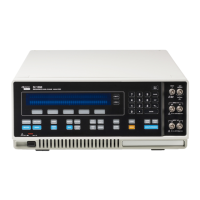
Making Measurements: The Analyzers 1250 Frequency Response Analyzer
5-4 AMK/1250/3
5.2.4 ORDER
Using Order Analysis, the 1250 computes the response of the system under test at the
first 16 harmonics of the analysis frequency, all within a single measurement period.
This is effectively a 'fast' harmonic analysis, since in the normal harmonic mode only the
selected harmonic response is computed within one measurement period. However,
Order Analysis does not work with AUTO ∫, and cannot be used when the analysis
frequency is greater than 650 Hz (or 400 Hz when Synchronising).
If Harmonic Analysis has also been set up, Order Analysis computes the 16 harmonics
of the chosen harmonic, rather than of the fundamental (generator) frequency.
For example, if HARMONIC (10) has been selected, then Order Analysis computes the
10th, 20th, 30th ..... 150th, and 160th harmonics of the measurement frequency,
provided that HARMONIC (10) is less that 650 Hz (or 400 Hz when Synchronising).
Setting up ORDER (2), for example, then displays the second of the 16 values viz: the
20th harmonic.
The Order Analysis facility is particularly useful in conjunction with the Synchroniser
Unit, Option 12501 (see Chapter 15, Section 1 for further explanation).
Note: REFORMAT (accessed via the DATA OUTPUT menu) must be 'on' when the
ORDER facility is in use.
5.2.5 AUTO ∫∫
When a signal contains random noise or other spurious components, it may be difficult
to decide how long an integration is required in order to give a result with acceptably
small error. The crude approach of providing plenty of time may entail a test sequence
that is unnecessarily lengthy, particularly if a succession of signals cover a wide
dynamic range and thus require different integration times.
With auto-integration the measurement is continued until either the variation in the
running average result becomes sufficiently small or the maximum time allowed has
expired. Two levels of acceptable variation are available, chosen by integrating for a
'short' or 'long' time, the readings being averaged until the Standard Deviation falls
below the limits:
short: = ±10% of reading ± 0.01% of full scale;
long: = ±1.0% of reading ± 0.001% of full scale.
Students 't' test is applied to the Standard Deviation to ensure a 90% confidence level.
The maximum time that the user is prepared to allow should be entered using the ∫
TIME key. If the 1250 has just been initialised, and no new value is entered here, the
default value is automatically increased when AUTO ∫ is enabled, to the longer of 3
cycles or 1 second. This is now the minimum time that can be set, i.e. auto-integration
relies on at least 3 readings.
If the maximum integration time is reached before the measured deviation has fallen
below the selected limit, a reading will still be displayed, but with ERROR 82 flagged as
a warning that the specified confidence level has not necessarily been achieved.
5.2.6 APPLICATIONS OF AUTO INTEGRATION
Where more than one Analyser is being used, auto-integration could usefully be
assigned to the channel with the worst signal-to-noise ratio. Once the chosen Standard
Deviation limit has been achieved on this channel, the measurement will terminate. It is
now probable that the readings on the less noisy channels will have even smaller
Standard Deviations.



 To Next Page