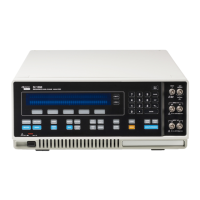
Making Measurements: The Analyzers 1250 Frequency Response Analyzer
5-8 AMK/1250/3
If taking single measurements, the Running Display will he updated once for each
operation of the ANALYZER SINGLE key. With ANALYZER RECYCLE commanded,
the Display is automatically updated as each measurement is completed.
The message in square brackets is the Mini Status Display and is explained in Chapter
7, Section 4.
5.5 STOPPING THE ANALYSER; STOP AND BREAK KEYS
When the Analyzer is on RECYCLE, it is normally stopped by pressing the ANALYZER
STOP key. The measurement then terminates when the current integration is complete.
This may take an unacceptably long time at very low frequencies, so if an immediate
stop is required, irrespective of validity of reading, press the BREAK key.
Also, if the Analyzer Status shows WAIT, this means that the Analyzer is waiting for
another section of the 1250 to complete its task. Pressing BREAK over-rides this and
returns control of the Analyzer to the Front Panel immediately. (Additional functions of
the BREAK key, which affect other sections of the instrument, are described in Chapter
14 Section 1 'The BREAK key').
5.6 CHANGING MENUS DURING RECYCLE
The Generator and Analyzer do not have to be stopped in order to change the Menus.
Any change that is entered will be held until the 1250 has completed the current
measurement. The alteration will then be implemented and the next measurement made
according to the new setting.
5.7 MEASUREMENT START POINT
The Analyzer must make its measurement with respect to some reference point on the
Generator waveform, known as the measurement start point. This start point varies
according to Generator frequency. At mid-frequencies, start will occur at the next 0°
crossing. At 4 Hz and below this could take an excessive time, so the period of one
cycle is divided into 104 equal parts, start occurring at the next 104th point. For
frequencies of approximately 655 Hz and above, integration occurs over blocks of 61
cycles, so start coincides with the beginning of the next 61-cycle block.
5.7.1 IMPLEMENTATION OF DELAY
As mentioned in Section 2.2, any Delay value entered is converted into a time period.
After this Delay time has elapsed, measurement commences at the next start point, as
defined above.



 To Next Page