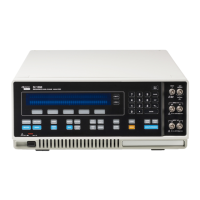
1250 Frequency Response Analyzer Options
AMK/1250/2 15-3
15.1.5 MODES OF OPERATION
There are four modes of synchroniser operation:
Off. In this mode, the 1250 behaves as though the 12501 is not present. Synchroniser
parameters can be entered but the measurements are unaffected by them. The "off'
state is selected via the SYNC soft key described in Section 1.6
Loose Lock. This mode is intended for use in conditions where the trigger signal is too
noisy for Tight Lock (see below) to be employed. The following sequence occurs before
measurement commences:
a. The frequency of the trigger signal is measured.
b. The 1250 Synthesizer is synchronised to this trigger frequency
c. The Analyzers are set to zero phase angle.
d. Finally a phase-locked loop is activated, which attempts to track changes in the
incoming trigger signal frequency.
This sequence is repeated before each measurement; consequently the 1250
measurement times will be longer than in non-synchroniser modes.
Once started, the measurement will proceed, and a reading will be displayed, even
though the trigger signal frequency may be varying. However, in extreme cases, where
dramatic changes occur in the trigger signal frequency during measurement, the
measurement time may become indeterminately long, and any readings may appear as
*. * * * *, indicating invalid results. The input trigger frequency should not be allowed to
change by more than 5% during a measurement.
If it is suspected that the measurement is not proceeding satisfactorily, control can be
restored to the Front Panel by pressing BREAK. The SYNC. LOCKED state can then be
re-established and a new measurement commenced.
Note that point to point measurements are particularly suitable in these conditions, as
any variations affect both channels simultaneously and hence errors are minimised.
Tight Lock. This mode is similar to Loose Lock, except that if the trigger signal
frequency changes by more than 0.5% in either 130 milliseconds or 1 cycle, whichever
is the longer, the measurement will not be started. This ensures, in most cases, that any
readings displayed are within the specified accuracy.
Ratio. In this mode, the input trigger frequency is computed as before, but the
Analyzers are set to measure at some multiple or sub-multiple of it, as programmed by
the user. There are two main applications:
a. Where a harmonic other than "1" has been selected, in which case Ratio mode is
entered automatically (unless Synchronisation is "off”).



 To Next Page