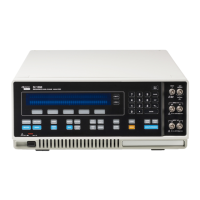
1250 Frequency Response Analyzer The RS423 and GPIB Ports. Remote Control
AMK/1250/4 13-23
13.12.4 DUMP MODE
This mode provides the fastest means of outputting data from the 1250. As the data is
in binary form, however, it is suitable only for processing by a computer or for storage
pending subsequent processing. Each reading is compressed into 12 bytes of binary
information.
The format is:
a a a a b b b b ƒƒƒƒ
which represents 3 X 4-byte floating point numbers, where:
a a a a = in phase data
b b b b = quadrature data
ƒƒƒƒ = frequency
If the Output Terminator, selected as described in Section 13.12.6, is either cr + EOI or
crlf + EOI, then EOI is automatically asserted simultaneously with the 12th byte. The cr
or crlf are not sent, neither is any Output Separator.
The output rate is approximately 1 byte per millisecond, as for the ASCII port, but the
data is compressed into only 12 bytes compared with up to 40 bytes for ASCII. Also, in
Dump mode, the 1250's internal computation time is much less.
13.12.5 FLOATING POINT FORMAT
To analyze the form of the Dump data in detail, consider, for example, the in-phase
component of the reading "a a a a". This consists of a 4-byte floating point number,
each byte containing 8 bits, as shown below:
Exponent, In 2's Complement Form
Byte 1 SIGN
Byte 2
•
/ 256
↑ BINARY POINT 3-Byte
Mantissa
Byte 3
/ 256
The sign bit in Byte 1 indicates the sign of the in-phase component. 0 indicates a
positive number and 1 a negative number.
The remaining seven bits of Byte 1 indicate the binary exponent, in 2's complement
format: 011 1111
2
≡ 2
63
≅ 9.2 x 10
18
• •
• •
000 0010
2
≡ 2
2
= 4
000 0001
2
≡ 2
1
= 2
000 0000
2
≡ 2
0
= 1
111 1111
2
≡ 2
-1
= 0.5
• •
• •
100 0000
2
≡ 2
-64
≅ 5.4 x 10
-20



 To Next Page