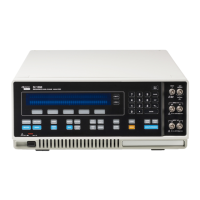
1250 Frequency Response Analyzer The RS423 and GPIB Ports. Remote Control
AMK/1250/4 13-21
13.11 MEASUREMENT OUTPUT RATE
13.11.1 VIA RS423 PORT
When using this port, the 1250 baud rate must be adjusted to suit the output device, as
explained in Section 13.3 of this Chapter.
13.11.2 VIA GPIB INTERFACE
When the 1250 is running in RECYCLE mode, some measurement results may be lost if
the Controller is not fast enough to assimilate all the data. The 1250 is capable of
sending approximately 10 readings per second to the ASCII port. The actual data
transmission is at approximately 1 byte per millisecond and each reading may occupy
up to 40 bytes. The remainder is measurement time.
There are two ways of ensuring that data is not lost:
1. Use RECYCLE mode, but with a Measurement Delay selected if necessary to allow
the Controller to keep pace with the data.
2. Use SINGLE mode to take a measurement, and pass the result to the GPIB. The
Controller then reads the data and, when ready, commands the 1250 to make the
next SINGLE measurement.
13.12 MEASUREMENT OUTPUT FORMAT
13.12.1 RS423 PORT
The results are presented in a tabulated format suitable for use with an RS423-
compatible printer, having a line width of 80 characters or more. Carriage Return is
automatically added as the Output Terminator.
Column headings may be either printed or suppressed as explained in Chapter 12,
Section 1.4 "Heading". The column sequence is of the form:
FREQUENCY REAL IMAGINARY LIMIT CHANNEL TIME STATUS
(HZ) (V) (V) CHECK & RANGE
Note: this is the or or or
measurement MAGNITUDE PHASE HISTORY
(V) or (dBV) (DEG) FILE NO
no units
for
point-to-point
13.12.2 GPIB TALK ONLY MODE
This mode of presenting measurement results to the GPIB is selected by setting the
TALK ONLY switch on the rear panel of the 1250 to ON. The 1250 then sends data to
the GPIB ASCII port in a format suitable for GPIB-compatible printers. The format is
the same as for the RS423 port, but the Output Terminator must be selected as
described in Section 13.12.6.



 To Next Page