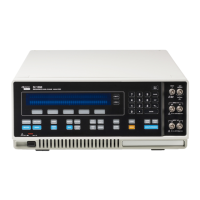
1250 Frequency Response Analyzer The 1251 Multichannel Analyzer System
AMK/1250/1 16-9
16.7.6 GPIB ADDRESSES
Viewed from a Controller, the host 1250 and the 1251 'slave' Units all appear as
separate instruments in that they have different GPIB addresses. However, whilst the
GPIB address of the 1250 can be either of two values (the Major and Minor addresses)
depending on the output mode adopted, a 1251 Unit has only one address whether
operating in ASCII or DUMP Output (binary) mode. Section 5.1, Chapter 13, explains
the dual address system.
16.7.7 1251 MULTICHANNEL ANALYSER OUTPUT: COMPLETE BLOCK
FORMAT
Like the 1250, the 1251 Unit outputs its measurements via the GPIB in two forms: ASCII
format, or DUMP mode (fast binary) format. The 1250 and 1251 formats are very
similar, but differ slightly because the 1251 format corresponds to a block of eight
readings, whereas each 1250 output is a single reading.
The general format of a complete eight-channel block of 1251 readings, whether in
ASCII or DUMP mode is:
frequency a b error code a b error code ... a b error code
channel 1 channel 2 channel 8
Data from the 1251 GPIB ports are always represented in the Cartesian coordinate
system (a = real component, b = imaginary component). However they may be
displayed on the 1250 front panel, or output through its ports, in any of the three
available coordinate systems.
16.7.8 ASCII FORMAT
In the ASCII format each measurement parameter is output as 11 characters (bytes),
comprising a 5-digit fixed point part and polarity sign, and a 2-digit exponent with
polarity sign; this is exactly as for the 1250 ASCII format (see Chapter 13, Section 12.3).
i.e. ± n . n n n n E ± n n
The error code format is always a single character, which takes the value of ASCII "1"
when the Analyser is overloaded, and ASCII "0" otherwise. Other Analyzer error codes
to do with Autointegration and Amplitude Compression are signalled by the 1250.
In the complete eight-channel data block each parameter is marked off by an Output
Separator (e.g. comma), and the complete block is terminated with an Output
Terminator (e.g. cr). A complete block of output takes the form:
± f. f f f f E ± f f, ± a
1
. a
1
a
1
a
1
a
1
E ± a
1
a
1 ,
± b
1
. b
1
b
1
b
1
b
1
E ± b
1
b
1 ,
e
1
, .......
± a
8
. a
8
a
8
a
8
a
8
E ± a
8
a
8 ,
± b
8 .
b
8
b
8
b
8
b
8
E ± b
8
b
8 ,
e
8
cr
where f represents the measurement frequency digits, and a
n,
b
n,
e
n
represent the nth
channel's measurement coordinates and error code respectively.
As with the 1250, the Output Terminator (e.g. cr) may be sent after each parameter if
required by setting the Output Terminator to be the Output Separator.



 To Next Page