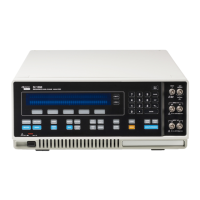
Facilities For More Complex Measurements 1250 Frequency Response Analyzer
10-6 CHFR/1250/1
10.1.5 LIMITS
The LIMIT soft key enables the user to assign a pair of values, called Upper and Lower
Limits, to any one of five parameters. The measured results can then be compared to
these values, results between the Limits being defined as Passes, those outside as
Fails.
Press the FUNTION key, followed by the LIMIT soft key. The default state is "off”,
followed by the five parameter choices obtained by operating the SELECT key, as
follows:
LIMIT CHECK [on a], [on b], [on r], [on θ] and [on log r].
Enter the required parameter. For any choice other than "off", the Display will request
further information.
For example, if [on a] is entered, following an initialisation, the Display will show:
UPPER LIMIT not entered (+ )V
Enter the required value for the Upper Limit in the round brackets; all Limit values can
be up to five digits plus decimal point and exponent. The Display will now show:
LOWER LIMIT not entered (+ )V
Enter the required Lower Limit. The Display will revert to show FUNCTION plus the soft
keys.
If [on a] is now accessed again, the current value will have replaced the "not entered"
message e.g.:
UPPER LIMIT "current value" (+ )V
Similarly, if Limits had already been entered for a previous measurement, with no
subsequent initialisation, these would have appeared instead of "not entered".
The setting up of Limits on the other parameters is similar, except that θ is in degrees
and log r in dB.
Limits can be set on only a single parameter at a time, namely the parameter last
SELECTed. which appears in square brackets:
LIMIT CHECK [on "parameter"].
If the measurement results have been stored in the File, new limits may be applied to
the original or to another parameter, when the results are read back from the File.



 To Next Page