Setting the battery lock
CAUTION
Risk of crushing and damage to property
An improperly fixed battery may fall out of the truck
when cornering and put people and property at risk.
If the battery cannot be clamped securely, the re-
sponsible service centre must be called. Further op-
eration with a faultily or improperly clamped battery is
dangerous.
To ensure the operational safety of this truck,
the traction battery must be securely fixed in
place in the battery compartment by means of
clamps. To achieve this, the truck is equipped
with an adjustable battery lock. The battery
lock can be adjusted by approx. 30 mm on
each side. Both locks must be adjusted sym-
metrically.
NOTE
When a battery is inserted into a chassis for
the first time, it is possible that the actions de-
scribed below may need to be repeated in
several steps. If the rubber buffer thread
(spring element) is not able to move smoothly,
this must be rectified before setting.
– Insert the battery approximately in the cen-
tre of the battery compartment. In doing so,
one of the battery locks will remain as a
stop in the truck.
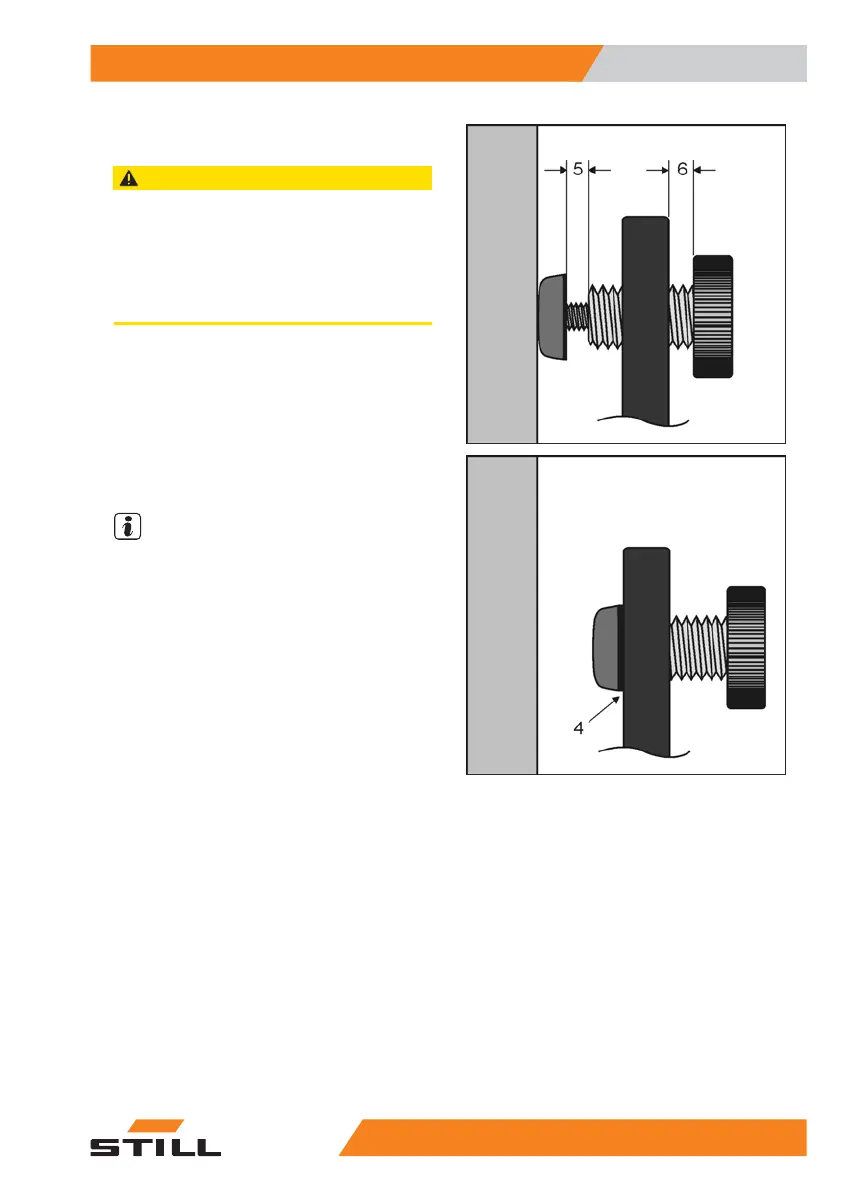
– Rotate the knurled-head screw (1) and the
rubber buffer (3) all the way back (4) on
both locks (2).
– Insert the second battery lock into the truck.
– Unscrew both rubber buffers until they lie
against the battery. The visible thread
length should be roughly the same on both
sides of the battery. Gently move the bat-
tery to the side, if necessary The maximum
adjustment range for each rubber buffer is
approximately 20 mm.
– If the useable threads on both rubber buf-
fers are not long enough to fasten the buf-
fers to the battery, the knurled-head screws
must be screwed in to further increase the
adjustment range. At the same time, the
Special equipment
7
Battery on a roller channel
1235231 804 2502 EN - 04/2020


 To Next Page