The information contained in this document is confidential, and only for the information of the intended recipient and may not be published or redistributed without the prior written consent of Summa NV.
Summa nv Tel +32 59 27 00 11 Fax +32 59 27 00 63 Email support@summa.com Website www.summa.com Page 14 of 76
• Check for strong light interfering with the pinch roller sensor, e.g. when the cutter is near a
window and direct sunlight is on the machine.
• On start of media loading, the cutter head should bounce to the right side as a reference.
Probably a mechanical obstruction prevents the cutter head going to the full right side,
causing the machine to use a wrong reference for detecting placement of the pinch rollers.
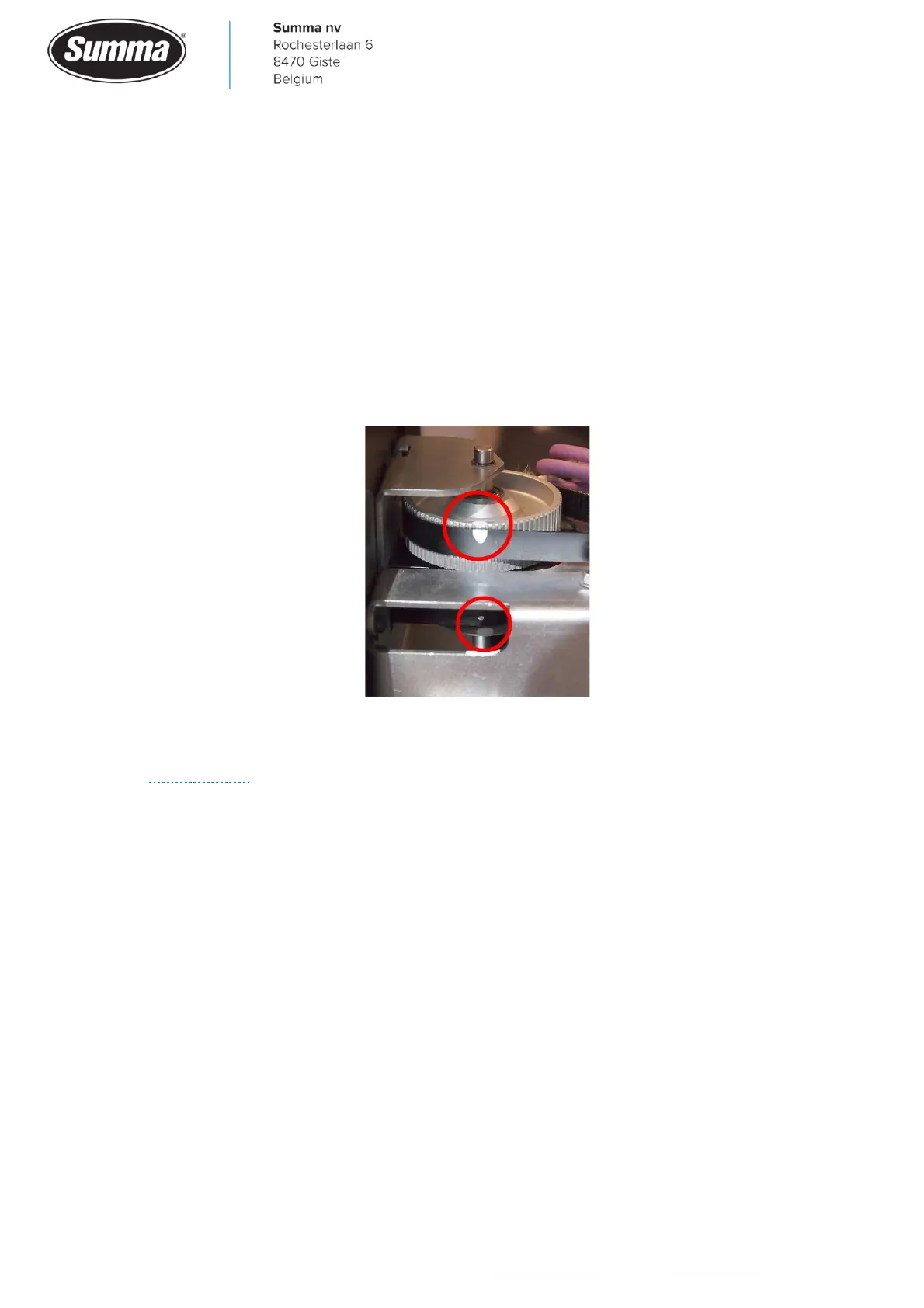
• The Y-belts may be worn. This causes the belt to jump over the teeth of the pulley. As a result
a wrong position is detected. To check for a worn Y-belt, move the cutter head completely to
the right side until the cut off mechanism touches the right side tab, then apply a mark on the
double pulley and belts. Run some jobs, and when a shift is suspected, move the cutter head
to the full right side, and verify the dots on the belt and pulley to match.
• The Y axis calibration may be off, causing the machine to assume the pinch rollers are at a
wrong position. Recalibrate the Y-axis: start the machine in service mode (see
“Service mode”), load media, then click [Settings] – [More] – [Calibrate X-Y].
• The pulley on the Y-motor may be loose.
• The encoder on the Y-motor may be defective causing to lose steps. Replace the Y-motor.
• The machine type has been set incorrect. Start the machine in service mode, confirm
[SERVICE MODE], then click [SERVICE] – [Machine type] and set the machine type correct to
match the hardware.
2.8 Unable to lower OPOS!
When the machine has to read the position of the OPOS registration marks, then the OPOS
sensor has to be lowered to the media to have a good focus of the light beam used. To lower
the OPOS sensor the knife is lifted to the upmost position. This position is controlled and
checked by means of the linear encoder (up/down encoder) in the cutter head. In case the
machine detects the knife cannot be lifted sufficient enough, then the up/down movement is



 To Next Page