Maintenance
2140−1/A1
Winterthur Gas & Diesel Ltd.
3/ 14
3. Removal
WARNING
Danger: If a gas detector
alarm is activated, keep
away from the engine. The
natural gas is flammable.
There is a risk of fire or
explosion.
WARNING
Injury Hazard: When you
open valves and shut-off
devices, hot fluids or
gases can be released. To
prevent injury, always open
slowly the valves and
shut-off devices. Look
away from the where the
gas is released.
Note: For safety it is recommended that
you have a portable gas detector.
Access to the gas admission valve (GAV)
on the fuel side is from the bottom platform,
through the clearance between the bottom
plates on the top platform.
Access to the GAV on the exhaust side is
on the same level as the top platform, below
the cylinder cooling pipes. These pipes
must be moved to get more access to the
GAV.
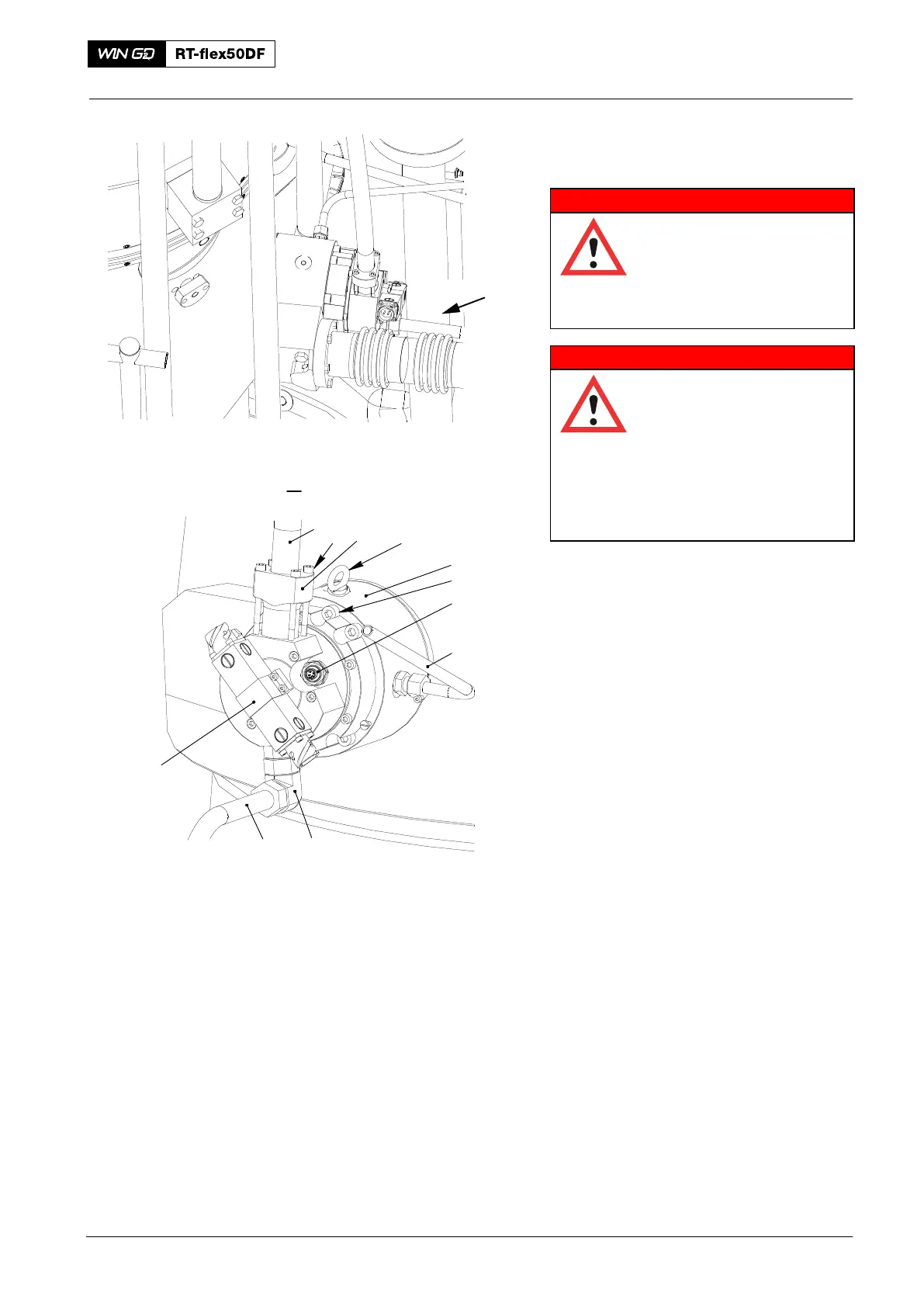
1) Put an oil tray under the GAV (5,
Fig. 2).
2) Make sure that the power supply to the
rail valve (10) is set to off.
3) Disconnect the electrical connections to
the rail valve (10) and the valve stroke
sensor (6).
4) Loosen the four screws (2).
Note: During step 5) make sure that you do not damage the sealing face of the
pipe (1)
5) Remove the pipe (1).
6) Remove the lubricating oil pipe (7) and the return pipe (9) from the GAV (4).
7) Seal the openings of the pipes (7, 9) with plugs to prevent contamination.
8) Install the eye bolt (94040-M8) to the GAV in the position shown.
9) Install an applicable lifting tool to the eye bolt.
10) Remove the six Allen screws (5).
11) Move the gas admission valve carefully to a clean working place.
12) Close the opening of the gas distribution pipe 2 with a flange or a plug.
2016
Gas Admission Valve: Removal, Disassemble, Assemble, Checks, Installation
WCH03403
94040−M8
I
2
3
1
5
6
7
4
8
9
10
Fig. 2
I



 To Next Page