2: Hardware Installation
Model SFP RJ-45
GE /
TE /
TE-R
Fiber SFP
100Base-
BX10D/BX10U/FX/FXFD/LX10
1000Base-
BX10D/BX10U/LX/LXFD/LX10
/SX/SXFD/T/TFD
(Auto-negotiation)
Copper SFP
10Base-TFD
100Base-TX/TXFD
1000Base-T/TFD
(Auto-negotiation/Auto MDIX)
10Base-THD/TFD
100Base-TX/TXFD
1000Base-T/TFD
(Auto-negotiation/Auto MDIX)
TE-S
Fiber SFP
100Base-
BX10D/BX10U/FX/FXFD/LX10
1000Base-
BX10D/BX10U/LX/LXFD/LX10
/SX/SXFD/T/TFD
(Auto-negotiation)
Copper SFP
10Base-TFD
100Base-TX/TXFD
1000Base-T/TFD
(Auto-negotiation/Auto MDIX)
10Base-THD/TFD
100Base-TX/TXFD
(Auto-negotiation/Auto MDIX)
The following describes the factory default configuration settings for all ports. Use the management web interface to
change these settings as required by your installation.
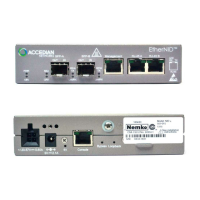
EtherNID EE
• Management: For connection of a local management station. By default, this port is set to the static IP address
192.168.1.254/24 and connection is made by using an SSL or SSH Client.
• Monitor 1: Configured for traffic monitoring.
• Monitor 2: Configured for traffic monitoring.
• RJ-45-A: This port is configured for connection to the client network.
• RJ-45-B: This port is configured for connection to the carrier network and is set to operate as a DHCP client.


 To Next Page