BACnet MS/TP Communication Data Bus Fundamentals
116 ECLYPSE User Guide
Data Bus Topology and EOL Terminations
Function of EOL Terminations
The first and last device on the data bus must have End-of-Line (EOL) termination resistors
connected across the two data lines/wires of the twisted pair. These resistors serve the
following purposes:
EOL terminations dampen reflections on the data bus that result from fast-switching
(high-speed rising and falling data edges) that otherwise would cause multiple data
edges to be seen on the data bus with the ensuing data corruption that may result. The
higher the baud rate a data bus is operating at, the more important that EOL
terminations be properly implemented. Electrically, EOL terminations dampen reflections
by matching the impedance to that of a typical twisted pair cable.
EIA-485 data bus transmitters are tri-state devices. That is they can electrically transmit
1, 0, and an idle state. When the transmitter is in the idle state, it is effectively offline or
disconnected from the data bus. EOL terminations serve to bias (pull-down and pull-up)
each data line/wire when the lines are not being driven by any device. When an un-
driven data bus is properly biased by the EOL terminations to known voltages, this
provides increased noise immunity on the data bus by reducing the likelihood that
induced electrical noise on the data bus is interpreted as actual data.
When to Use EOL Terminations
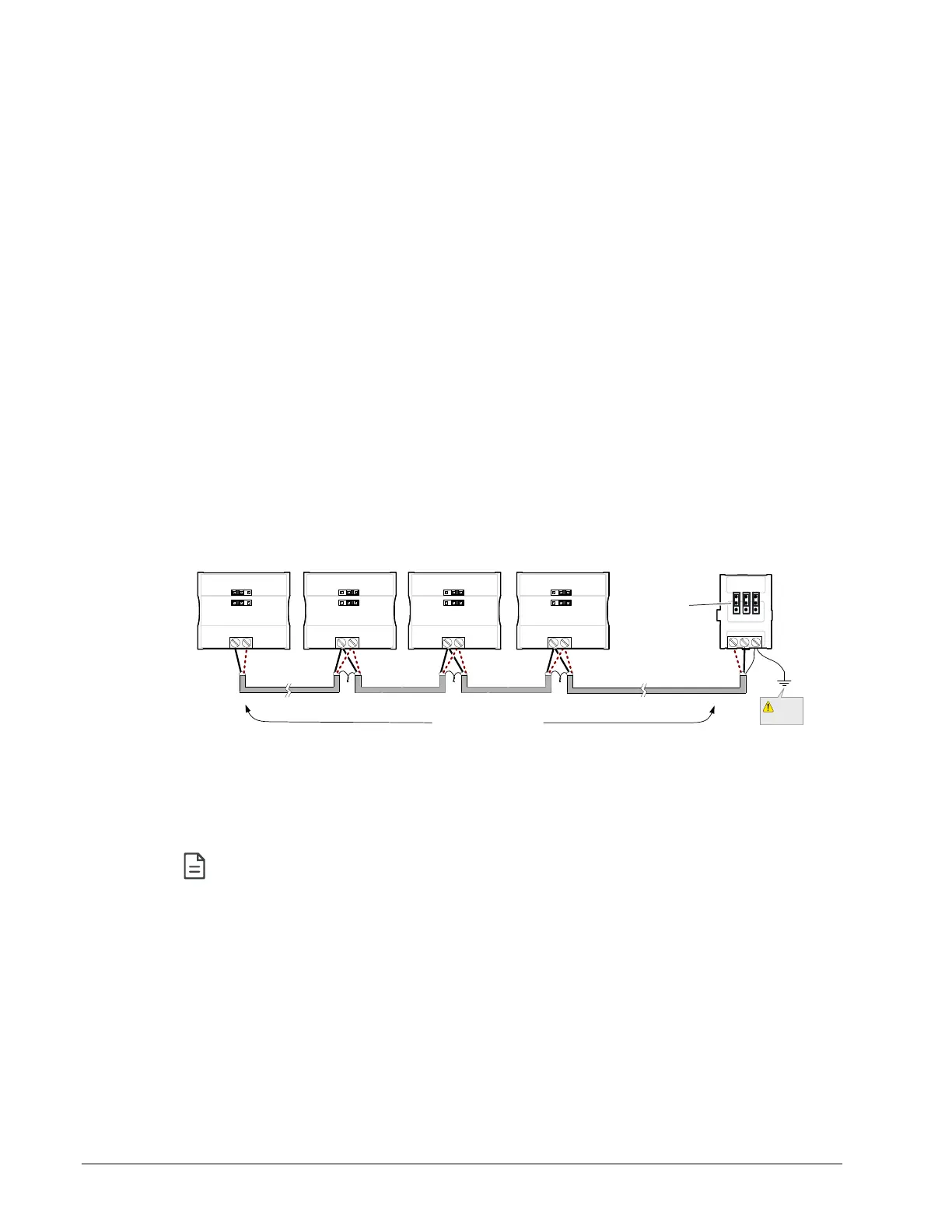
EOL terminations should only be enabled / installed on the two devices located at either end
of the data bus. All other devices must not have the EOL terminations enabled/installed.
ECY-S1000
NET-
NET +
S
Typical BACnet Device
First and last daisy-chained device:
- EOL Terminations are ENABLED
OR EOL resistor is installed
All other Devices:
- EOL Terminations are DISABLED
EOL ENABLED: For the
ECY-S1000 as a first or
last daisy-chained
device: set the EOL
Termination internally
NET+
NET-
Typical BACnet Device
NET+
NET-
Typical BACnet Device
NET+
NET-
Typical BACnet Device
NET+
NET-
EOL ON
EOL OFF
EOL OFF
EOL OFF
Data Bus: Shielded Twisted Pair Cable
Electrical
System
Ground
Figure 11-2: EOL Terminations Must be Enabled at Both the First and Last Device
on the Data Bus
Devices with built-in EOL terminations are factory-set with the EOL termination disabled by
default.
The BACnet/IP to MS/TP Adapter does not have EOL Termination (and BACnet
MS/TP Data Bus biasing) capabilities to be used at the end of a BACnet MS/TP
data bus. Instead, use the BACnet/IP to MS/TP Router for this application.
When to use EOL Terminations with BACnet MS/TP
Thermostats
BACnet MS/TP thermostats support external EOL termination resistors only. When a
BACnet MS/TP thermostat is the first or last daisy-chained device, add a 120 Ohm resistor
across the – and + BACnet MS/TP data bus connections.
The BACnet MS/TP data bus must be biased. This bias can only be provided by built-in EOL
termination resistors (ones set with jumpers or DIP switches – refer to the controller’s
Hardware Installation Guide for how to identify and set a controller’s built-in EOL
terminations). If a BACnet MS/TP data bus has a BACnet MS/TP thermostat at one end of



 To Next Page