Connecting IP Devices to an IP Network
ECLYPSE User Guide 39
or Wi-Fi stumbling tool on a laptop computer. This software shows the currently operating
Wi-Fi networks operating within range, their signal strength, and their channel number so as
to make the best configuration choices.
Radio Signal Transmission Obstructions
Radio signals are electromagnetic waves; hence the further they travel, the weaker the
signal becomes thereby limiting effective range of operation. Coverage is further decreased
by specific materials found in the direction of the transmission. For example, while radio
waves can penetrate a wall, they are dampened more than if the waves were on a direct
line-of-sight (LoS) path.
The following table shows the different types of building materials and range reduction:
Wood, drywall, glass (uncoated, without metal)
Metal, steel-reinforced concrete, mirrors
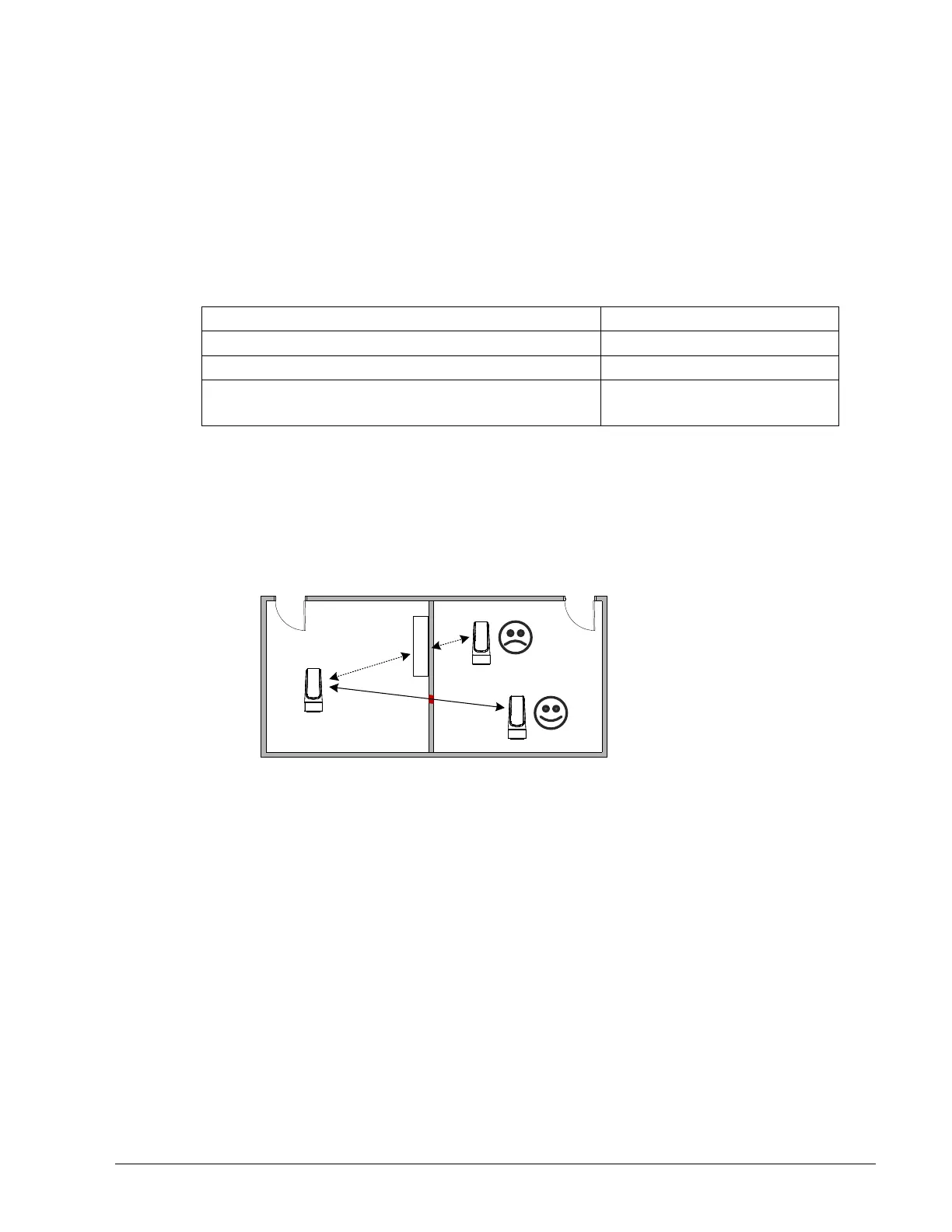
See also Figure 5-9.
Where to Locate Wireless Adapters
When installing the wireless adapter, it is important to ensure that distances and obstructions
do not impede transmission. Metallic parts, such as steel reinforcement in walls, machinery,
office furniture, etc. are major sources of field strength dampening. Furthermore, supply
areas and elevator shafts should be considered as complete transmission screens (Figure
5-9).
Figure 5-9: Screening of Radio Waves
Transmission Obstructions and Interference
One way to get around an obstruction, such as a duct, is to place the wireless adapter on the
side of the obstruction that is nearer to the coordinating wireless device, even if the controller
is on the opposite side of the obstruction. But always keep in mind that the wireless adapter
performs best when it is away from metal objects or surfaces (more than 1" (2.5 cm)).
For more examples on how to position the wireless adapter, refer to section ECLYPSE Wi-Fi
Adapter Mounting Tips on page 40.
In addition to obstructions, the angle with which the transmission travels through the
obstruction has a major influence on the field strength. The steeper the angle through an
obstruction, the radio wave has to travel through more material resulting in the field strength
reduction (Figure 5-10). Therefore it is preferable that the transmission be arranged so that it
travels straight and perpendicularly through the obstruction.



 To Next Page