BACnet MS/TP Communication Data Bus Fundamentals
126 ECLYPSE User Guide
BACnet MS/TP Data Bus Token-Passing Overview
The BACnet MS/TP data bus protocol is a peer-to-peer, multiple-master protocol that shares
data bus bandwidth by passing a token between Master devices on the data bus that
authorizes the device that is holding the token to initiate communications on the data bus.
Once the device has completed its request(s), it closes the communications channel, passes
the token to the next Master device (making it the current Master), and liberates the data
bus.
The token is passed through a short message from device to device on the BACnet MS/TP
data bus in consecutive order starting from the lowest MAC address (MAC Address = 0) to
the next MAC Address.
Gaps or pockets of unassigned device MAC Addresses should be avoided as this reduces
data bus performance. Once a master has finished making its requests, it must poll for the
next master that may exist on the Data Bus. It is the timeout for each unassigned MAC
Address that slows down the data bus.
The way MAC Addresses are assigned is not a physical requirement: Devices can be daisy-
chained on the data bus in any physical order regardless of their MAC Address sequence.
The goal is to avoid gaps in the device MAC Address range.
Slave devices cannot accept the token, and therefore can never initiate communications. A
Slave can only communicate on the data bus to respond to a data request addressed to it
from a Master device. Gaps in slave device MAC Addressing have no impact on BACnet
MS/TP data bus performance.
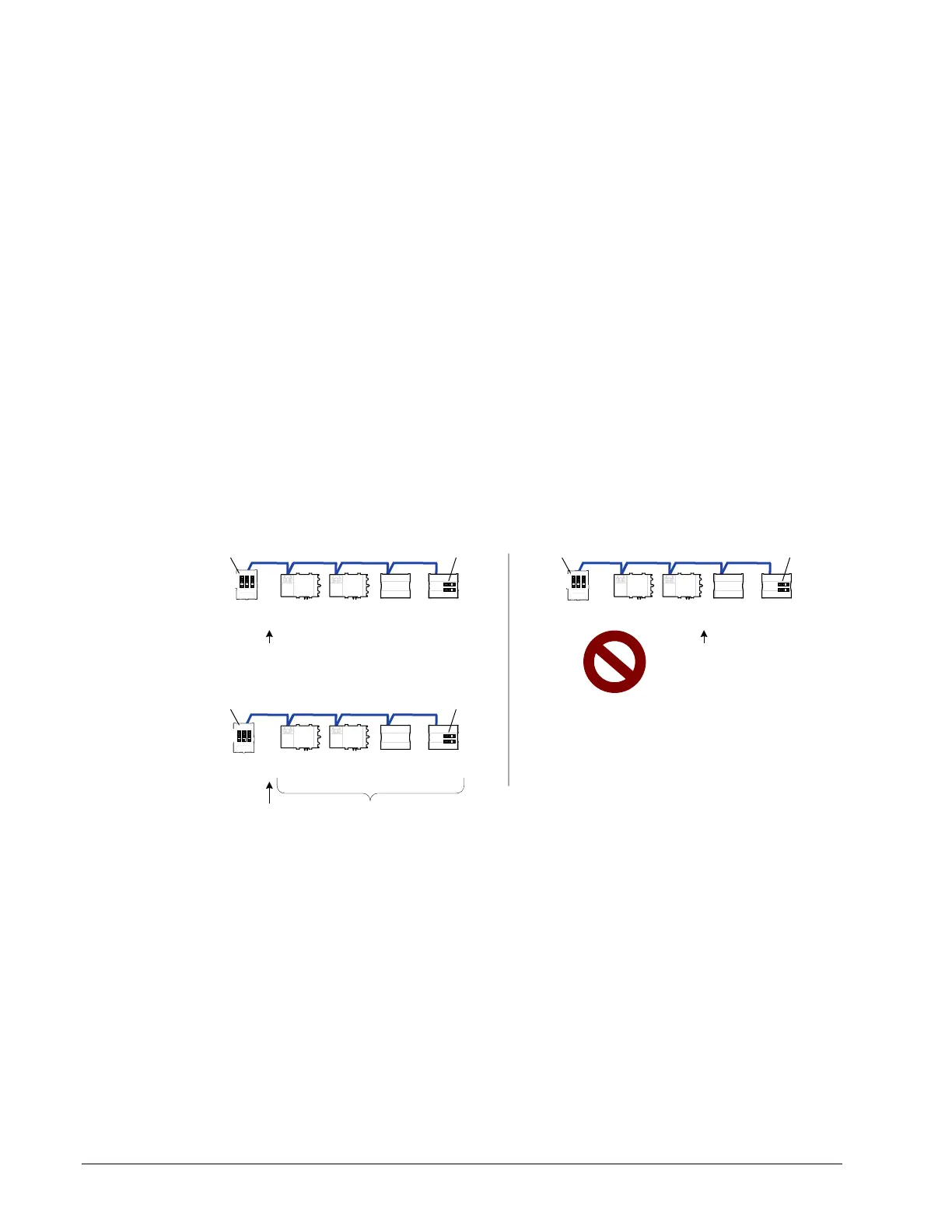
No MAC Address Gaps
MAC: 0
DI: 10 000
MS/TP
Network # 10
MAC: 3
DI: 10 003
MAC: 4
DI: 10 004
MAC: 5
DI: 10 005
MAC: 6
DI: 10 006
MAC Address 1 & 2 are Reserved
for Maintenance Purposes
MAC: 0
DI: 10 000
MS/TP
Network # 10
MAC: 6
DI: 10 006
MAC: 5
DI: 10 005
MAC: 3
DI: 10 003
MAC: 4
DI: 10 004
MAC Address 1 & 2
are Reserved for
Maintenance Purposes
The Physical Order
of MAC Addresses
is Unimportant
MAC Address Gaps (To Avoid)
MAC: 0
DI: 10 000
MS/TP
Network # 10
MAC: 3
DI: 10 003
MAC: 4
DI: 10 004
MAC: 25
DI: 10 025
MAC: 26
DI: 10 026
Avoid MAC Address Gap
EOL Internally Set
EOL Internally Set
EOL Internally Set
EOL
ON
EOL
ON
EOL
ON
ECY-S1000
ECY-S1000
ECY-S1000
EOL
ON
EOL
ON
EOL Internally Set
EOL Internally Set
EOL
ON
EOL Internally Set
Figure 11-15: Setting the Max Master on the ECY Series Controller to the Highest
MAC Address Used on the BACnet MS/TP Data Bus
About Tuning the Max Info Frames Parameter
Once a device has the token, it can make a number of information requests to other devices
on the BACnet intranetwork. The maximum number of requests is limited by the
Max Info Frames parameter. Once the device has made the maximum number of requests
it is permitted to make according to the Max Info Frames parameter, the device passes the
token to the following device with the next higher MAC address. This makes the BACnet
MS/TP Data Bus more reactive for all devices by preventing a device from hanging on to the
token for too long. Ordinary BACnet MS/TP devices should have the Max Info Frames
parameter set to between 2 and 4. The Data Bus Master (ECY Series Controller) should
have the Max Info Frames parameter set to 20.



 To Next Page