ES910.3-A - User’s Guide 34
ETAS Functional Description
“Advanced” Mode
The “Advanced” operating mode provides a number of other possibilities.
The 100 Mbit/s Block ETK protocol results in increased ETK interface perfor-
mance. The most important advantages in comparison to the “Compatibility”
operating mode are:
• 16 rates for measuring,
• 16 rates for rapid prototyping and the
• possibility to configure the number of variables per measure rate.
4.11 IO Interface (IO)
The ES910.3-A has one IO interface for modules of the ES4xx line. This IO inter-
face is routed to an 8-pin IO connector (Lemo socket) on the back panel of the
device and is galvanically isolated from the other interfaces of the ES910.3-A.
4.11.1 Operating Modes
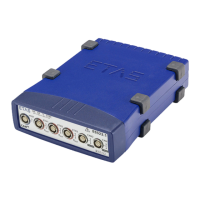
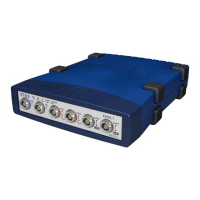
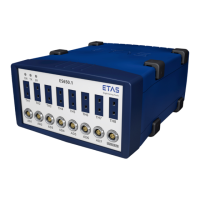
The IO interface can be used either for the connection of ES4xx/ES63x/ES93x
modules in a decentral ETAS Ethernet topology (daisy chain) or when connecting
to an EtherCAT bus as EtherCAT slave device.
Selecting the operating mode of the IO interface and its configuration is done on
the web interface of ES910.3-A (see chapter 5.6.5 on page 62).
4.11.2 "Daisy Chain" Operating Mode
In the "Daisy Chain" operating mode, an ES4xx/ES63x/ES93x module chain can
be connected to the IO interface. The signals acquired by the modules are avail-
able directly in the ES910.3-A. The function model running in the ES910.3-A can
use this data.
For data transfer, the ES400 modules use a 100 Mbit/s Ethernet network connec-
tion in duplex operation. The universal ASAM measure and calibration protocol
XCP is used for serial communication. On the Ethernet transport and network
layer, the UDP/IP protocol is used. Within the XCP protocol, the modules transfer,
among other things, module ID, time stamp and measure and/or stimulation
data in an extremely precise and predictable time pattern. The communication
protocol used for the ES400 family avoids repeated transfer of protocol data,
which takes place, for example, in handshake-based systems. This makes a high
bandwidth available for reference data.
The IO interface of ES910.3-A does not supply the modules of the ES4xx/ES63x/
ES93x module chain with operating voltage. The modules are thus powered on
at the ES910.3-A with the Y cable CBEP430 or CBEP4305 (see chapter 5.5.3
on page 58).
The simultaneous use of these operating modes at the IO interface of an
ES910.3-A module is not possible.
In the delivery state, the IO interface is configured for operation with ETAS
daisy chain modules.


 To Next Page