ES910.3-A - User’s Guide 16
ETAS Hardware Description
3 Hardware Description
This chapter provides you with an overview of the ES910.3-A with information
on the housing, serial number, interfaces and indicators.
3.1 Overview
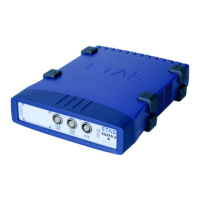
Rapid prototyping can be executed with the compact module ES910.3-A. The
ES910.3-A has a simulation controller and the ECU interfaces CAN, LIN, ETK and
XETK and also one interface for Daisy Chain modules (ES4xx/ES63x/ES93x mod-
ules). If additional interfaces are required, the extension slot of the ES910.3-A
can be used with the ES920.1 FlexRay module, the ES921.1 CAN module or with
the ES922.1 CAN FD module. The Service Port provides the functions “Wake
Up” and “Trigger”. The ES910.3-A is supported by INCA as an interface for mea-
sure, calibration and diagnostic applications.
3.1.1 Rapid Prototyping of Software Functions
In this context, rapid prototyping refers to processes which enable early control
of the specifications in close-to-production vehicles. The fact that new develop-
ments are tested and confirmed at an early stage reduces the risks, increases the
quality of the development, and reduces the development time and thus the
costs.
The modeled software function is to be implemented as a prototype. Rapid pro-
totyping systems can be used as an execution platform for the software portions
of the control and diagnostic functions. They are then linked to the generators,
sensors, actuators, and ECUs of the vehicle. Due to these interfaces to the vehi-
cle, the software functions must be executed in the rapid prototyping system –
as in the ECU – while meeting real-time requirements.
Rapid prototyping systems are usually real-time computer systems with signifi-
cantly higher computing performance than ECUs. Rapid prototyping systems can
be configured, depending on the application, e.g., regarding the required inter-
faces for input and output signals. The entire system is designed for use in the
vehicle and is operated, e.g., using a PC. The software function can be tested
and modified directly in the vehicle.
In the bypass application, new or modified software functions are specified by a
model and run on the rapid prototyping system.
This approach is suited for enhancing existing functions. The existing functions in
the control unit are often still calculated but modified, so that the input values
are sent via the bypass interface, and the output values from the new bypass
function are used.
3.1.2 ES910.3-A Features
Overview of the major features of the ES910.3-A:
• Highly efficient, compact development and experimental platform with
high computing and simulation performance due to the use of a close-to-
target, fast floating-point processor.
• Smooth transition from the finished function prototype to ECU software
development by using the AUTOSAR-compatible RTA-OSEK operating sys-
tem.
• 1 Gbit/s Ethernet connection to the PC


 To Next Page