Address Setting
The address of the module during the slave mode will be stored in the I²C Bus Address Register
(IBAD) on the 7-bit field ADR.
Transfer setting
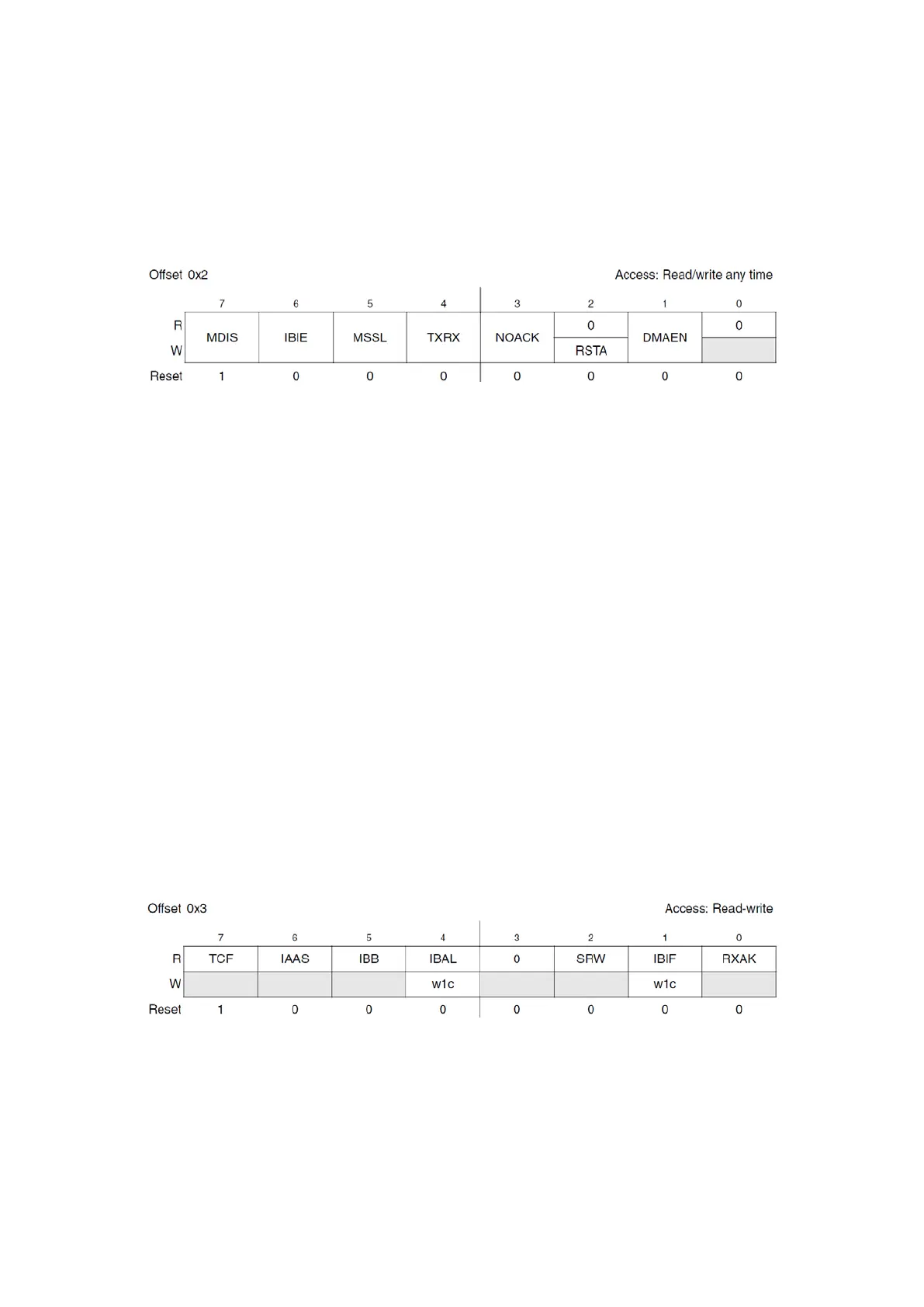
For configuring various aspects of the module, I²C BUS Control Register (IBCR) can be used.
Figure 107 : I²C Bus Control Register (R.M. Rev8 – Fig. 20-6)
Details about modifiable fields of this register:
o MDIS: Module Disable, this bit is set on reset and it has to be cleared before using
this module.
o IBIE: I-Bus Interrupt Enable, I²C interrupts are enabled, related to the flag IBIF
on the status register.
o MSSL: Master/Slave mode select, 0 for slave and 1 for master. On a change from
0 to 1, a START signal is automatically generated and on the reverse change, a
STOP signal will be generated. This bit is automatically cleared if the master loses
arbitration.
o TXRX: Transmit/Receive mode select, 1 for transmit. When operating as a slave,
this bit should be set according to the demands of the master, and when
operating as a master, it is used during the address cycle for informing the slave.
o NOACK: Data Acknowledge Disable, when this bit is set, no acknowledge signal
will be sent. Used for stopping communication when reading as a master.
o RSTA: Repeat Start, when 1 is written to this bit, a repeated START condition will
be generated. This can be used for changing TX/RX mode, but if it is used while
another master is controlling the bus, then a loss of arbitration will occur.
Status/Interrupt Management
Figure 108 : I²C Bus Status Register (R.M. Rev8 – Fig. 20-6)
The I²C Bus Status Register (IBSR) contains flags that are useful during communication in order
to determine the next set of actions. Different bits are:
TCF: Transfer Complete flag, when 0, a transfer is in progress and when at high a transfer
is complete. (It is at ‘1’ by default).



 To Next Page