any problem, but if it’s above then we’ll have to wait the counter to roll-over for getting normal
operation.
MCB: Modulus Counter Buffered
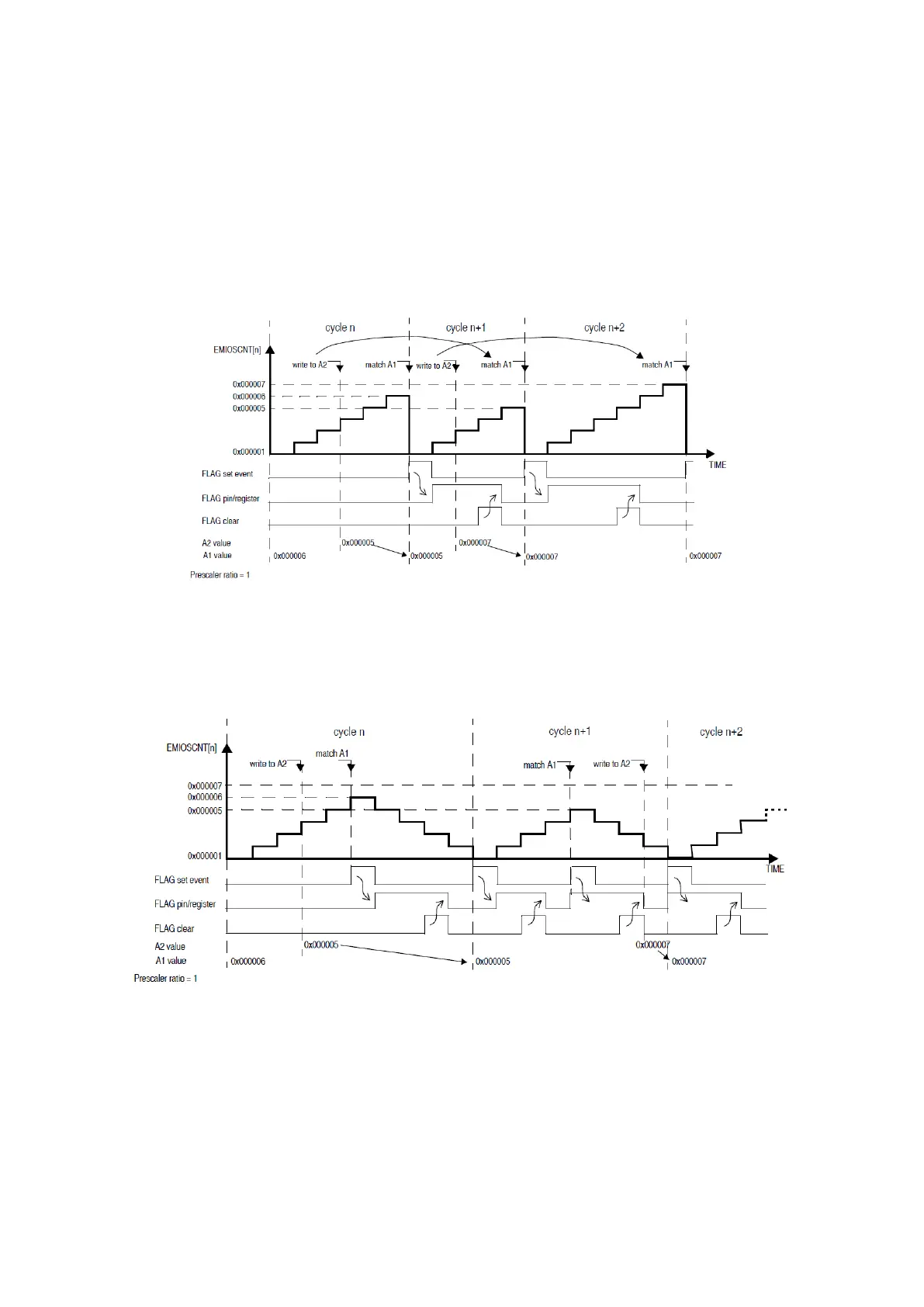
In this Modulus Counter Buffered mode (MODE[0:6]=1010b0b), the register A is double
buffered, allowing smoother transitions when the value of A is changed. The match register A1 is
only updated at the end of a cycle, avoiding the need of wait for a roll over. Another main
difference with the MC mode is that the counter counts between 0x1 and A1 value.
Figure 55 : MCB Up Counter Mode Example (R.M. Rev8 – Fig. 24-32)
The configurable bits MODE[4] and MODE[6] have the exact same effect as on the MC mode.
When the counter is in up mode, the period will take A1 cycles and when it is in up/down mode
it will take 2(A1-1) cycles.
Figure 56 : MCB Up/Down Counter Mode Example (R.M. Rev8 – Fig. 24-33)
MCB should be preferred over MC for clock generation.
OPWFMB: Output Pulse Width and Frequency Modulation Buffered
The Output Pulse Width and Frequency Modulation Buffered mode (MODE[0:6]=10110b0) is
used to generated waves with variable duty cycle and frequency. This mode automatically uses
the internal channel counter as it’s time base and comparators on A1 and B1.



 To Next Page