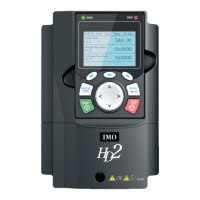
HD2 Series Inverter Quick Startup
-6-
4. Check whether the humidity of application site exceeds 90%, if yes, check whether
condensation occurred, if condensation does exist, take additional protective measures.
5. Check whether there is direct sunlight or animal intrusion in the application site, if yes, take
additional protective measures.
6. Check whether there is dust, explosive, or combustible gases in the application site, if yes,
take additional protective measures.
Note: For a cabinet installed inverter, its ambient temperature is the air temperature inside the
cabinet.
2.5 Installation confirmation
After the inverter is installed properly, check the installation condition of the inverter.
1. Check whether the input power cable and current-carrying capacity of the motor cable fulfill
actual load requirements.
2. Check whether peripheral accessories (including input reactors, input filters, output
reactors, output filters, DC reactors, braking units, and braking resistors) of the inverter are
of correct type and installed properly; check whether the installation cables fulfill
requirements on current-carrying capacity.
3. Check whether the inverter is installed on fire-retardant materials; check whether the hot
parts (reactors, braking resistors, and so on) are kept away from combustible materials.
4. Check whether all control cables are routed separately from power cables based on EMC
requirements.
5. Check whether all grounding systems are properly grounded according to requirements.
6. Check whether inverter installation clearances meet the requirements in the operation
manual.
7. Check whether the inverter installation mode complies with the requirements in the
operation manual. Vertical installation should be adopted whenever possible.
8. Check whether inverter external connection terminals are securely wired with proper
moment.
9. Check whether there are redundant screws, cables, or other conductive objects inside the
inverter. If yes, take them out.
2.6 Basic commissioning
Carry out basic commissioning according to the following procedures before operating on the
inverter.
1. Select motor type, set motor parameters, and select inverter control mode according to
actual motor parameters.
2. Check whether autotuning is needed? If possible, disconnect the motor load to perform
dynamic parameter autotuning. If the load cannot be disconnected, perform static
autotuning.
3. Adjust the acceleration and deceleration time based on actual load working conditions.


 To Next Page