TROUBLESHOOTING
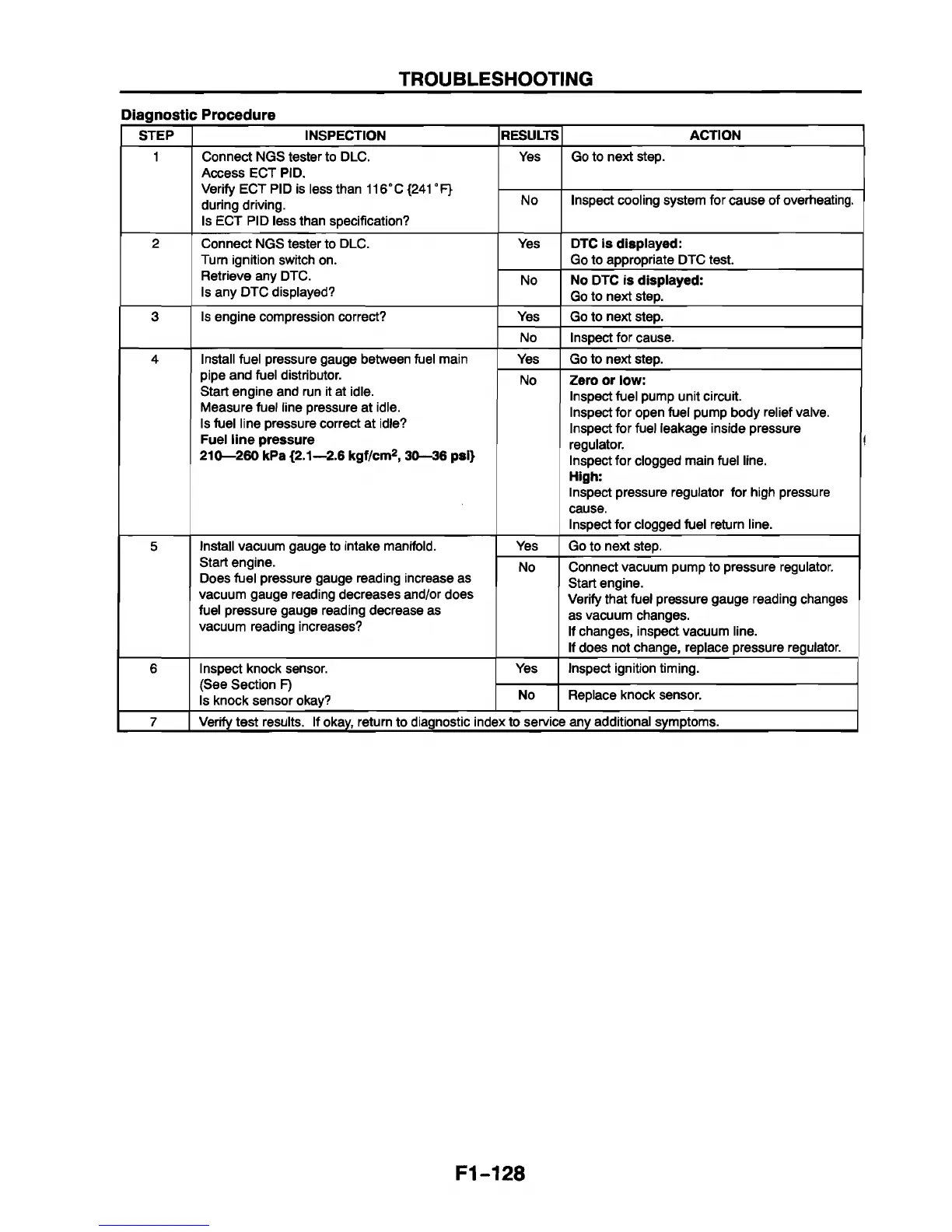
Diagnostic Procedure
STEP
INSPECTION RESULTS
ACTION
1 Connect NGS tester to DLC.
Access ECT PID.
Verify ECT PID is less than 116‘ C {241 °F}
during driving.
Is ECT PID less than specification?
Yes Go to next step.
No Inspect cooling system for cause of overheating.
2
Connect NGS tester to DLC.
Turn ignition switch on.
Retrieve any DTC.
Is any DTC displayed?
Yes DTC is displayed:
Go to appropriate DTC test.
No
No DTC is displayed:
Go to next step.
3
Is engine compression correct?
Yes Go to next step.
No Inspect for cause.
4 Install fuel pressure gauge between fuel main
pipe and fuel distributor.
Start engine and run it at idle.
Measure fuel line pressure at idle.
Is fuel line pressure correct at idle?
Fuel line pressure
210—260 kPa {2.1—2.6 kgf/cm2, 30—36 psi}
Yes Go to next step.
No
Zero or low:
Inspect fuel pump unit circuit.
Inspect for open fuel pump body relief valve.
Inspect for fuel leakage inside pressure
regulator.
Inspect for clogged main fuel line.
High:
Inspect pressure regulator for high pressure
cause.
Inspect for clogged fuel return line.
5 Install vacuum gauge to intake manifold.
Start engine.
Does fuel pressure gauge reading increase as
vacuum gauge reading decreases and/or does
fuel pressure gauge reading decrease as
vacuum reading increases?
Yes
Go to next step.
No Connect vacuum pump to pressure regulator.
Start engine.
Verify that fuel pressure gauge reading changes
as vacuum changes.
If changes, inspect vacuum line.
If does not change, replace pressure regulator.
6
Inspect knock sensor.
(See Section F)
Is knock sensor okay?
Yes Inspect ignition timing.
No Replace knock sensor.
7
Verify test results. If okay, return to diagnostic index to service any additional symptoms.
F1-128


 To Next Page