TROUBLESHOOTING
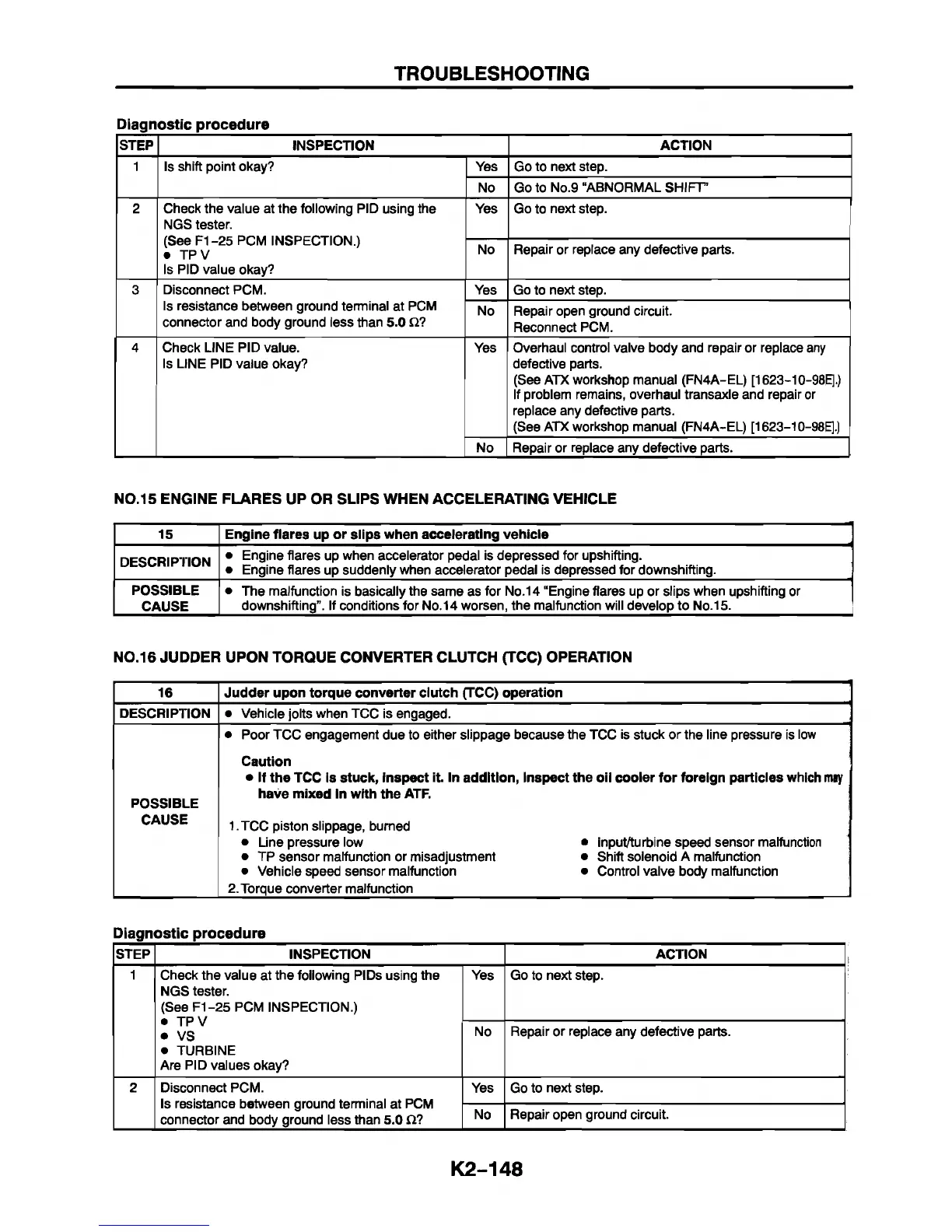
Diagnostic procedure
STEP INSPECTION
ACTION
1 Is shift point okay? Yes Go to next step.
No
Go to No.9 “ABNORMAL SHIFT’
2 Check the value at the following PID using the
NGS tester.
(See F1 -25 PCM INSPECTION.)
• TPV
Is PID value okay?
Yes
Go to next step.
No Repair or replace any defective parts.
3 Disconnect PCM.
Is resistance between ground terminal at PCM
connector and body ground less than 5.0 Q?
Yes Go to next step.
No Repair open ground circuit.
Reconnect PCM.
4
Check LINE PID value.
Is LINE PID value okay?
Yes Overhaul control valve body and repair or replace any
defective parts.
(See ATX workshop manual (FN4A-EL) [1623-10-98E].)
If problem remains, overhaul transaxle and repair or
replace any defective parts.
(See ATX workshop manual (FN4A-EL) [1623-10-98E].)
No Repair or replace any defective parts.
NO.15 ENGINE FLARES UP OR SLIPS WHEN ACCELERATING VEHICLE
15 Engine flares up or slips when accelerating vehicle
DESCRIPTION
• Engine flares up when accelerator pedal is depressed for upshifting.
• Engine flares up suddenly when accelerator pedal Is depressed for downshifting.
POSSIBLE
CAUSE
• The malfunction is basically the same as for No.14 “Engine flares up or slips when upshifting or
downshifting”. If conditions for No.14 worsen, the malfunction will develop to No.15.
NO.16 JUDDER UPON TORQUE CONVERTER CLUTCH (TCC) OPERATION
16 Judder upon torque converter clutch (TCC) operation
DESCRIPTION
• Vehicle jolts when TCC is engaged.
POSSIBLE
CAUSE
• Poor TCC engagement due to either slippage because the TCC is stuck or the line pressure is low
Caution
• If the TCC is stuck, inspect it. In addition, Inspect the oil cooler for foreign particles which may
have mixed in with the ATF.
1 .TCC piston slippage, burned
• Line pressure low • input/turbine speed sensor malfunction
• TP sensor malfunction or misadjustment • Shift solenoid A malfunction
• Vehicle speed sensor malfunction • Control valve body malfunction
2. Torque converter malfunction
Diagnostic procedure
STEP
INSPECTION ACTION
1
Check the value at the following PIDs using the
NGS tester.
(See F1-25 PCM INSPECTION.)
• TPV
• VS
• TURBINE
Are PID values okay?
Yes Go to next step.
No Repair or replace any defective parts.
2
Disconnect PCM.
Is resistance between ground terminal at PCM
connector and body ground less than 5.0 ft?
Yes Go to next step.
No
Repair open ground circuit.
K2-148



 To Next Page