www.mdcusa.com
Ph: 1-833-632-8721
©Copyri ght
Tire Safety & Maintenance
This section of the User Manual contains tire safety information as required by 49 CFR 575.6.
Determining Correct Load Limit
Trailers 10,000 Pounds GVWR or Less
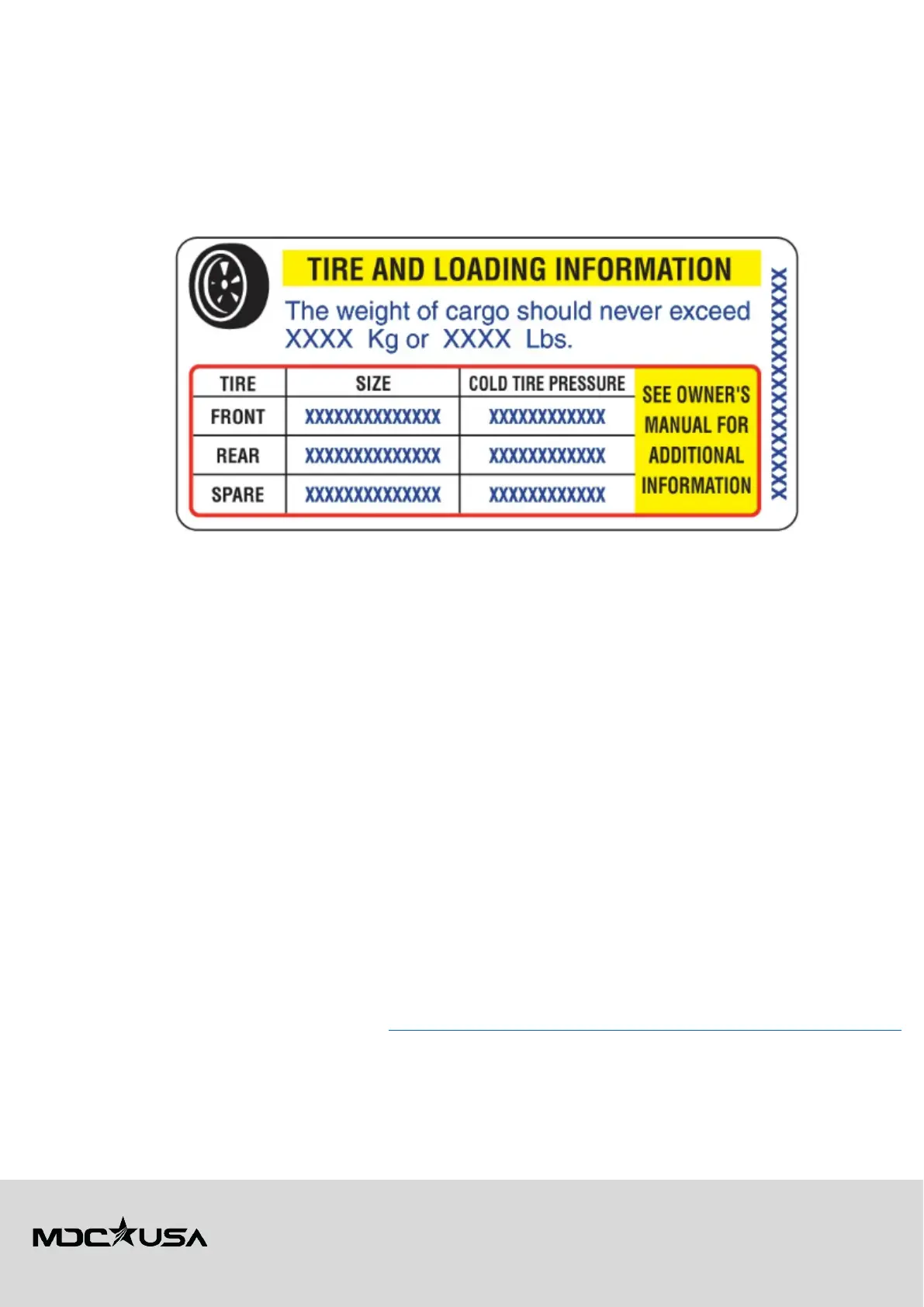
1. Locate the statement “The weight of cargo should never exceed XXX kg or XXX lbs” on your vehicles placard. See figure 1-1
2. This figure equals the available amount of cargo and luggage load capacity.
Tire and Loading Information Placard – Figure 1-1
3. Determine the combined weight of luggage and cargo being loaded on the vehicle. That weight may not safely exceed the
available cargo and luggage load capacity.
The trailer’s placard refers to the Tire Information Placard attached adjacent to or near the trailer’s VIN (Certification) label at
the left front of the trailer.
Note: The following calculations in Sections 2.1.2 and 2.2 are not required by the government. For the purpose of completeness,
NATM has included these statements.
Steps for Determining Load Limit – TOW VEHICLE
1. Locate the statement, “The combined weight of occupants and cargo should never exceed XXX lbs.,” on your vehicle’s
placard.
2. Determine the combined weight of the driver and passengers who will be riding in your vehicle.
3. Subtract the combined weight of the driver and passengers from XXX kilograms or XXX pounds.
4. The resulting figure equals the available amount of cargo and luggage capacity. For example, if the “XXX” amount equals
1400 lbs. and there will be five 150 lb. passengers in your vehicle, the amount of available cargo and luggage capacity is 650
lbs. (1400-750 (5 x 150) = 650 lbs.).
5. Determine the combined weight of luggage and cargo being loaded on the vehicle. That weight may not safely exceed the
available cargo and luggage capacity calculated in Step # 4.
6. If your vehicle will be towing a trailer, load from your trailer will be transferred to your vehicle. Consult the tow vehicle’s
manual to determine how this weight transfer reduces the available cargo and luggage capacity of your vehicle.
Tire Safety – Everything Rides on it
The National Traffic Safety Administration (NHTSA) has published a brochure (DOT HS 809 361) that discusses all aspects of
Tire Safety, as required by CFR 575.6. This brochure is reproduced in part below. It can be obtained and downloaded from
NHTSA, free of charge, from the following web site: http://www.nhtsa.dot.gov/cars/rules/TireSafety/ridesonit/tires_index.html
Studies of tire safety show that maintaining proper tire pressure, observing tire and vehicle load limits (not carrying more weight
in your vehicle than your tires or vehicle can safely handle), avoiding road hazards, and inspecting tires for cuts, slashes, and
other irregularities are the most important things you can do to avoid tire failure, such as tread separation or blowout and flat
tires. These actions, along with other care and maintenance activities, can also:
• Improve vehicle handling.
• Help protect you and others from avoidable breakdowns and accidents.






 To Next Page