www.mdcusa.com
Ph: 1-833-632-8721
©Copyri ght
Load Placement
Where you place the items in your trailer will affect how it behaves. Loading too much weight in the extremities of the trailer can
have an unbelievably adverse effect. MDCUSA owner manuals have a loading guide to assist in this area. By following the guide
and tongue weight recommendations you will achieve the best possible result. Use the load placement guide in this manual as a
reference for packing your RV.
Tongue (Coupler) Weight
The ratio of overall weight of the trailer to the weight exhibited on the tow ball or coupler is an extremely
important aspect of making a trailer handle correctly when towed. The tongue weight allowed by most vehicle
manufacturers is 10% of the maximum towing capacity. Given this ratio, the RV industry builds trailers and
campers with this in mind. When loading your MDCUSA trailer, you should have a target tongue or coupler
weight of 10% or slightly higher to ensure the weight balance is at an ideal starting point. This figure should not
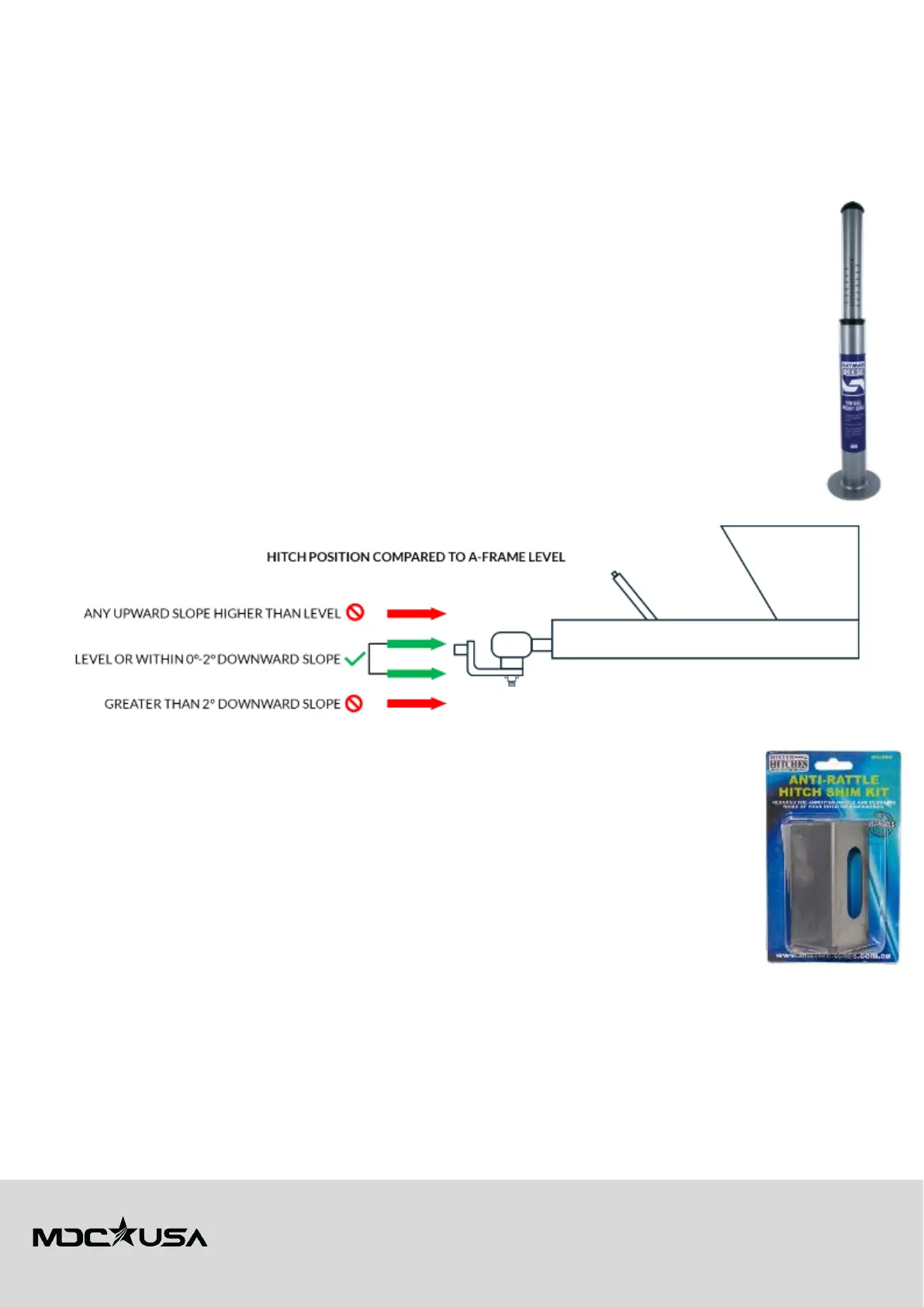
be a guess, you should weigh your trailer with its normal load when travelling and use a ball weight scale to
achieve the desired tongue weight. These are an inexpensive item that will help you get the weight balance right
when you load up for your trip.
Trailer Levelling
The height of your hitch in relation to the level of the trailer significantly impacts the handling characteristics
while being towed. For optimal performance with your MDCUSA trailer, it is recommended that when the trailer
is loaded and hitched to the towing vehicle, the drawbar should be no higher than the comparative level of the
trailer A-frame. Ideally, the hitch should sit slightly lower than level, with a downward angle between 0 and 2
degrees. If the drawbar is higher than level or excessively low, it can negatively affect towing stability and
handling.
Hitch Movement
Most modern tow bars have an adjustable screw fitted to the hitch receiver that can be used to stop the
hitch insert from rattling. Unfortunately, this is not a sure-fire way to limit sideways movement that can
affect how well your trailer tows. Hitch movement from side to side can cause sway and when combined
with a tow vehicle that has a greater distance between the rear axle center and the hitch point, this affect
can cause serious sway issues. Combine this with poor tire pressures on the tow vehicle and you have a
recipe for disaster.
If there is excess play in the hitch and hitch receiver, you may need to place shims either side of the insert
to limit the movement. Shims are commercially available such as the pack beside.
Vehicle Squat
When the back of a vehicle squats due to cargo and/or tongue weight of the trailer, the handling of the tow vehicle can be
changed to its detriment. Vagueness in steering, poor toe, camber, and caster settings due to reduced front suspension load,
reduced brake and tire grip are often the result. All this in turn can result in a poorly handling towing combination. The best way
to rectify this is upgrading the tow vehicle suspension to be suitable for the weights being experienced. Some vehicle
manufacturers recommend Weight Distribution Hitches (WDH), this will be outlined in the vehicle owner manual and should be
considered. You should also consult with the trailer manufacturer if this is an appropriate fitment to the trailer. The WDH should
NOT be used in offroad operation as it will NOT meet the required articulation that will be experienced. To better setup your
tow vehicle suspension, it is best to consult a suspension expert experienced with towing requirements.



 To Next Page