www.mdcusa.com
Ph: 1-833-632-8721
©Copyri ght
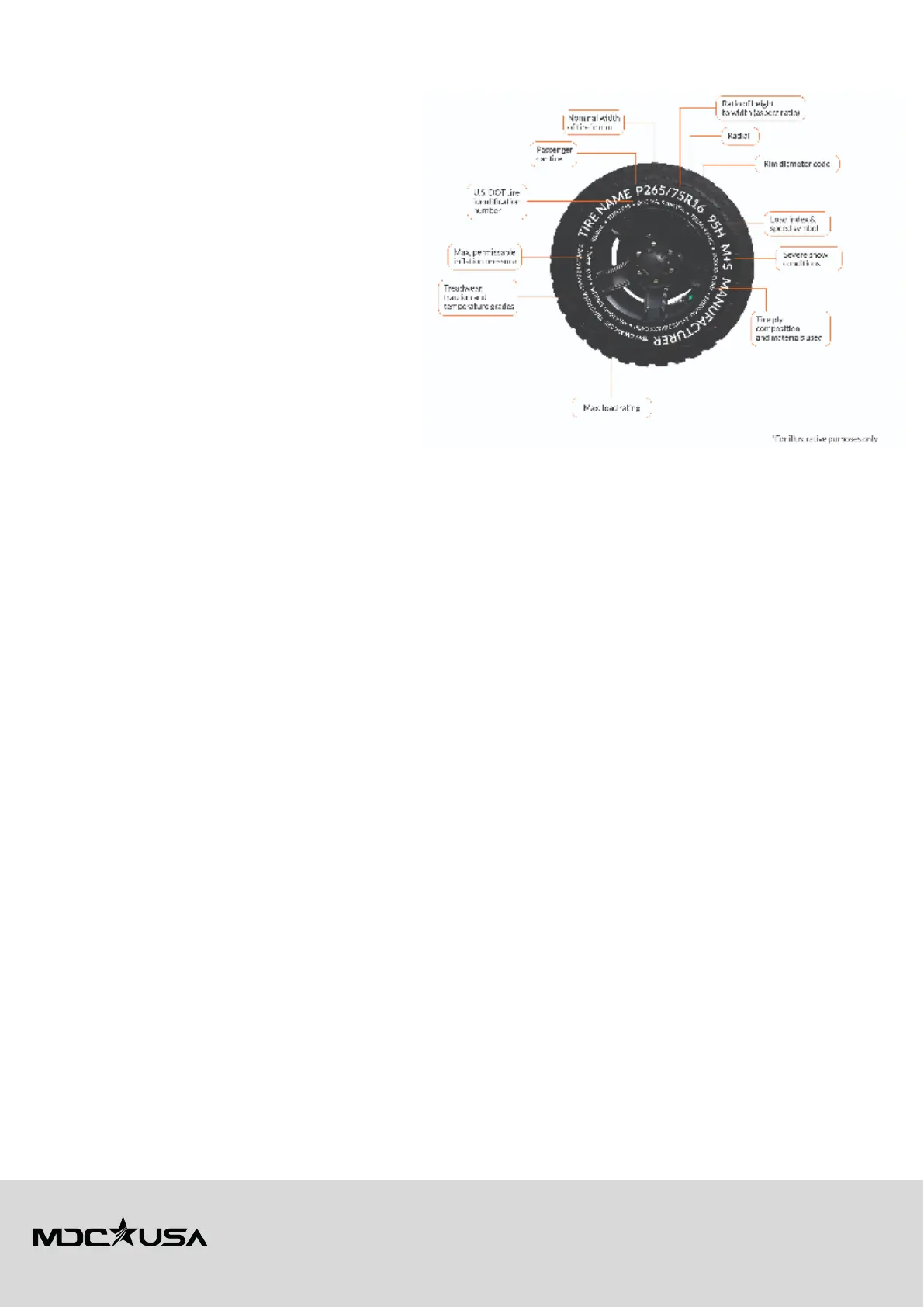
Understanding Tire Sizes & Treadware Ratings
Information on Passenger Vehicle Tires
P
The “P” indicates the tire is for passenger vehicles.
Next number
This three-digit number gives the width in millimetres
of the tire from sidewall edge to sidewall edge. In
general, the larger the number, the wider the tire.
Next number
This two-digit number, known as the aspect ratio,
gives the tire’s ratio of height to width. Numbers of 70
or lower indicate a short sidewall for improved
steering response and better overall handling on dry
pavement.
R
The “R” stands for radial. Radial ply construction of
tires has been the industry standard for the past 20
years.
Next number
This two-digit number is the wheel or rim diameter in inches. If you change your wheel size, you will have to purchase new tires
to match the new wheel diameter.
Next number
This two- or three-digit number is the tire’s load index. It is a measurement of how much weight each tire can support. You may
find this information in your owner’s manual. If not, contact a local tire dealer. Note: You may not find this information on all
tires because it is not required by law.
M+S
The “M+S” or “M/S” indicates that the tire has some mud and snow capability. Most radial tires have these markings; hence,
they have some mud and snow capability.
U.S. DOT Tire Identification Number
This begins with the letters “DOT” and indicates that the tire meets all federal standards. The next two numbers or letters are
the plant code where it was manufactured, and the last four numbers represent the week and year the tire was built. For
example, the numbers 3197 mean the 31st week of 1997. The other numbers are marketing codes used at the manufacturer’s
discretion. This information is used to contact consumers if a tire defect requires a recall.
Tire Ply Composition and Materials Used
The number of plies indicates the number of layers of rubber-coated fabric in the tire. In general, the greater the number of
plies, the more weight a tire can support. Tire manufacturers also must indicate the materials in the tire, which include steel,
nylon, polyester, and others.
Maximum Load Rating
This number indicates the maximum load in kilograms and pounds that can be carried by the tire.
Maximum Permissible Inflation Pressure
This number is the greatest amount of air pressure that should ever be put in the tire under normal driving conditions.
Treadwear Number UTQGS Information
This number indicates the tire’s wear rate. The higher the treadwear number is, the longer it should take for the tread to wear
down. For example, a tire graded 400 should last twice as long as a tire graded 200.
Traction Letter
This letter indicates a tire’s ability to stop on wet pavement. A higher graded tire should allow you to stop your car on wet
roads in a shorter distance than a tire with a lower grade. Traction is graded from highest to lowest as “AA”, ”A”, “B”, and “C”.



 To Next Page