www.mdcusa.com
Ph: 1-833-632-8721
©Copyri ght
• Monitor the ONE Core Display or the DC Home app to ensure balanced charging between the roof-mounted solar system
and auxiliary inputs.
• If using multiple panels, ensure that each panel has its own charge controller and that the total system charge rate does not
exceed battery safety thresholds.
Understanding MPPT Charging and Solar Performance
How MPPT Charging Works
The Maximum Power Point Tracking (MPPT) technology in your Renogy REGO 60A MPPT Solar Charge Controller and Renogy
50A Dual Input DC-DC Battery Charger with MPPT plays a crucial role in optimizing solar energy harvesting. Unlike
conventional charge controllers, MPPT technology actively monitors
voltage (V) and current (A) to ensure that your solar panels
operate at their most efficient power output.
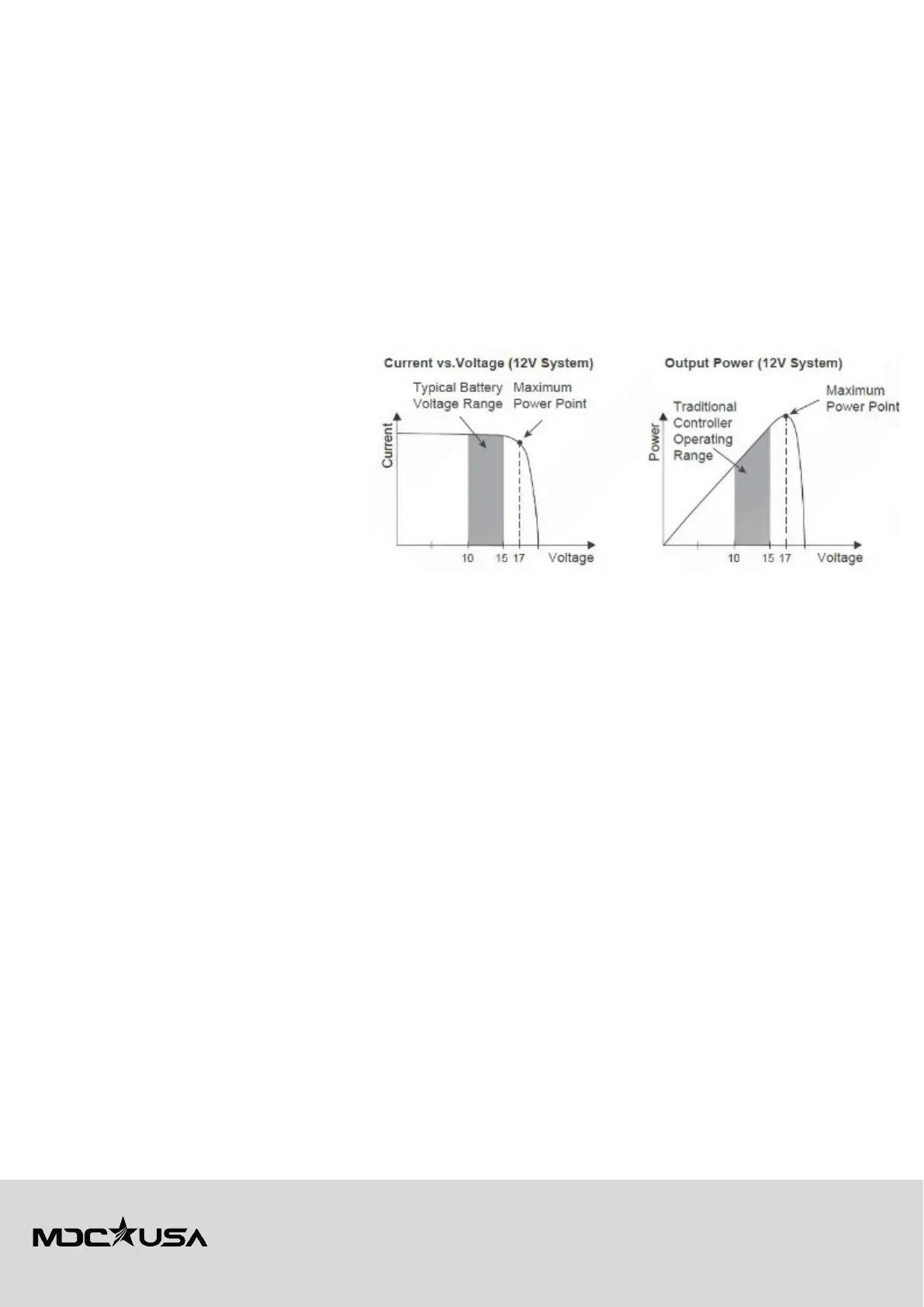
The Power Curve and MPPT Tracking
Each solar panel has a unique Current vs. Voltage (I-V) Curve and Power vs. Voltage (P-V) Curve, which change throughout the
day due to variations in
sunlight intensity, panel temperature, and shading.
• Traditional Controllers (PWM) operate at
the
battery voltage, which may not align
with the panel’s optimal voltage. This leads
to power loss.
• MPPT Controllers scan the panel's
voltage and dynamically adjust the system
to find the
Maximum Power Point (MPP)—
the point at which voltage and current
combine to produce the
highest possible
wattage.
Example MPPT Calculation:
A 100W panel operating at its MPP (17V, 5.9A) delivers:
17 × 5.9 = 100
A PWM controller running the same panel at a battery voltage of 13V results in a lower current output:
13 × 5.9 = 76.7
This loss of ~23W is avoided with MPPT, as it steps down voltage while increasing current proportionally.
Current Boosting with MPPT
MPPT controllers regulate voltage downward to match the battery, but in doing so, they increase current to maintain full power
output. This is why a
higher voltage solar array can still efficiently charge a 12V battery.
For example, if a solar panel operates at 18V and 6A, the MPPT regulator steps it down to match a 12V battery but increases
current to maintain power:
18 × 6 = 108( )
12 × 9 = 108(ℎ )
Thus, MPPT boosts the charging current, reducing charge time and improving efficiency.
In summary, MPPT controllers significantly improve solar charging efficiency by dynamically adjusting to extract maximum
available power from the solar panels. This results in higher energy yield, increased charging current, and shorter battery
recharge times, especially in variable weather conditions. Compared to PWM controllers, MPPT can recover up to 30% more
power, making it the preferred choice for off-grid energy systems.
Managing Expectations for Solar Performance
While MPPT (Maximum Power Point Tracking) technology optimizes solar power conversion, real-world performance depends
on multiple factors:















 To Next Page