www.mdcusa.com
Ph: 1-833-632-8721
©Copyri ght
Towing Your Travel Trailer
Weights and Payload Capacities
The information plate attached to the drawbar of your trailer displays the relevant weights and weight capacities of the van.
How to Load Your Trailer
It is important to load your RV correctly to distribute weight evenly and achieve a suitable tongue weight load and prevent
loading in a manner that can cause a trailer to sway and/or roll excessively left and right. The industry optimum ball weight on a
caravan is between 9 and 11% of the total trailer weight. MDCUSA travel trailers fit into this category and 10% should be used
as the starting point.
TONGUE LOADING (DOWNWARD LOAD ON TOW HITCH) MUST NOT
EXCEED 772lbs OR THE MAXIMUM ALLOWABLE LOAD BY THE
VEHICLE MANUFACTURER OR TOW BAR RATING, WHICH EVER IS
THE LOWEST. Exceeding these limits may result in an accident,
causing severe injury or death and/or property damage.
• Always load evenly to both sides of the trailer.
• Load heavy weight over or as close to over the axle as possible and as low as possible.
• Overhead cupboards should only be used for lightweight items such as clothes, personal items, bedding etc.
• Heavy cooking equipment should be stored in lower cupboards.
• Canned food, bottled goods for cooking, etc, should be stored in the pantry cupboard.
• Never load in a manner that causes the tongue weight to exceed the limit of the tow vehicle.
• Ensure no items can move during travel. Secure all items to prevent damage to the RV.
• Consider water tank levels and how they may affect the balance front and back and the percentage of ball
weight.
• Never store heavy items in overhead cupboards.
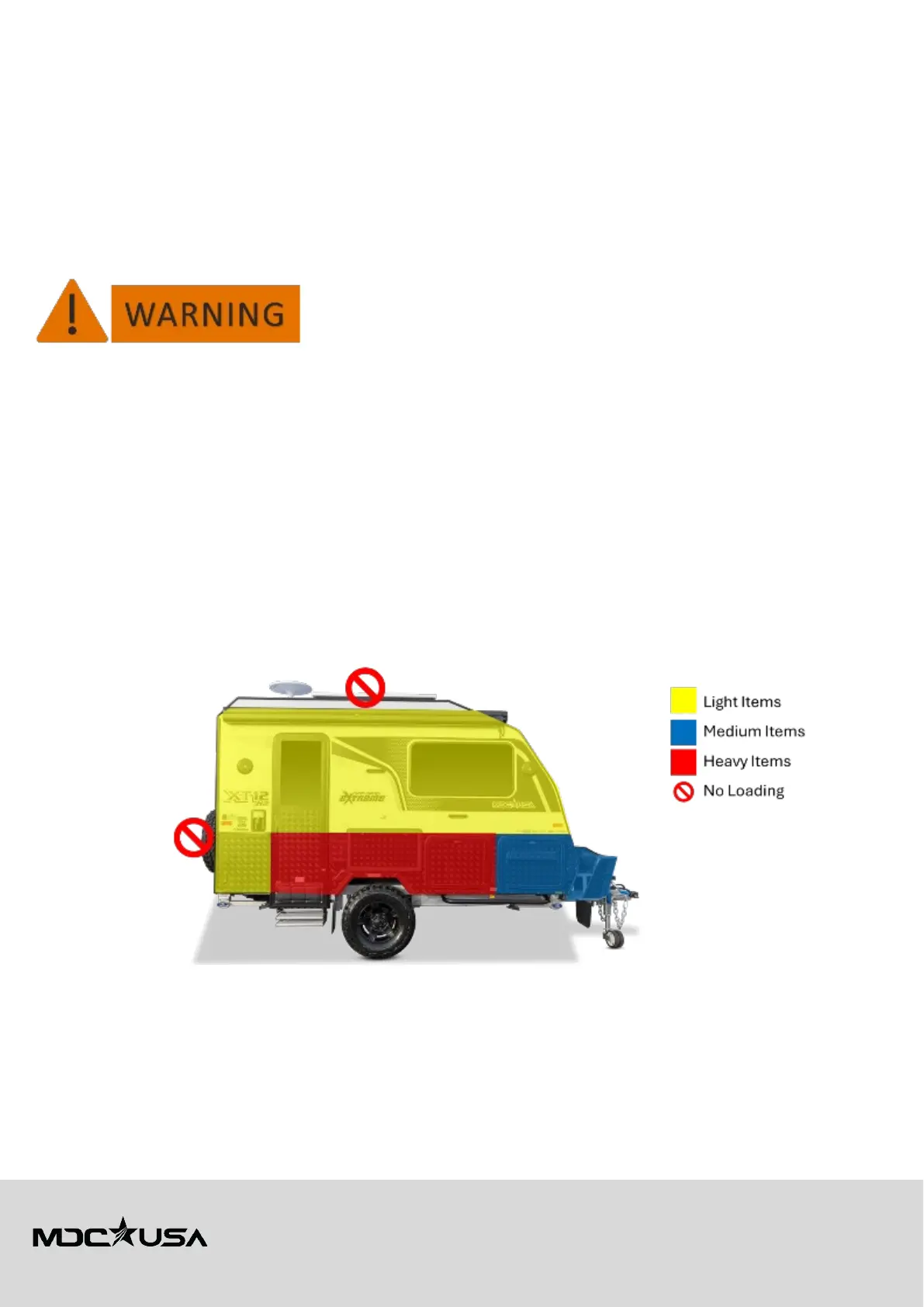
Load Distribution Guide
The diagram below illustrates best placements of items based on weight.
Tongue Weight
When loading your RV, the accepted tongue weight once loaded is around 10% of the total weight of the trailer. Use a ball
weight scale to identify the ball weight and load the RV in a manner that achieves the desired weight. Ideally, once loaded the
first time, take the trailer to a scale, and measure the total weight loaded including the weight on the jockey wheel. When the
total weight is known, adjust the load locations to meet the desired balance considering 10% is the accepted benchmark.
Effects of Weight Distribution
The distribution of weight in a trailer can influence the handling and performance. Overloading the front or rear may cause
adverse handling and sway. Additionally, overloading the front or back can induce a pendulum effect that can cause dangerous
sway and cause an accident.



 To Next Page