A-1
Annex A: Glossary
Measurement axes (isotropic / single axis measurement)
The measurement of the magnetic flux density / field strength present at a
given point requires the determination of the field strength components in
the three orthogonal vector directions. These three mutually perpendicular
measurement axes are normally designated as x, y and z respectively.
If the sensors in the measurement probe are suitably aligned (on three
axes), the probe itself does not need to be specially aligned in the field. This
is known as an isotropic measurement.
It is easier to localize hidden field sources / leaks if the measurement is
made in one axis only. In this case, only one of the sensor signals is
evaluated. The probe is moved to give the maximum readout during the
measurement. The markings on the probe can then be used to deduce the
location of the field source.
Field probes
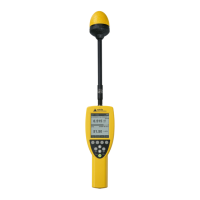
All the field probes available are suitable for isotropic measurements. The
directions of the x, y and z measurement axes are clearly marked on the
probe.
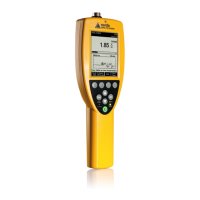
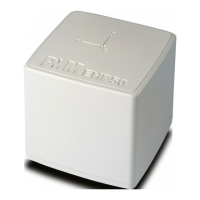
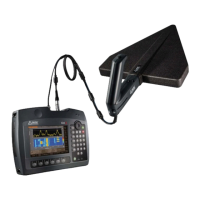
If an external B-Field Probe / E-Field Unit is connected to the Basic Unit, this
will be detected automatically and the measurement input switched
accordingly.
RMS value (RMS)
The RMS value of the magnetic flux density is calculated from the RMS
values through for the magnetic flux densities in the three
measurement axes.
The RMS value is independent of the time-domain phases of the three field
components.
The RMS value for electric field strength is calculated in the same manner.
B
˜
B
˜
x
B
˜
z
B
˜
B
˜
x
2
B
˜
y
2
B
˜
z
2
++=


 To Next Page