Because RFL™ and Hubbell® have a policy of continuous product improvement, we reserve the right to change designs and specifications without notice.
The basic objective of any troubleshooting procedure is to determine the type and location of a
problem. Once this is accomplished, taking one of the following actions will usually restore the IMUX
2000 system:
1. For setup problems, re-configure the IMUX 2000 multiplexer or multiplexers that are not set up
correctly.
2. For public network problems, work with your Local or Inter-exchange carrier to correct the
situation. For private network problems, consult the network manager.
3. For equipment problems, replace the bad module or modules with spares.
9.2.2 GENERAL TROUBLESHOOTING HINTS
Use the following hints as general guides when troubleshooting an IMUX 2000 system:
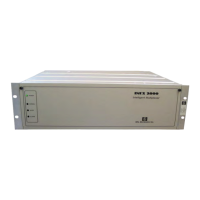
1. At each location, verify that the POWER LED on the IMUX 2000 Main Shelf is on. If there is
an expansion shelf in the location and it has its own power supply, verify that its POWER LED
is on as well. If the POWER LED is off, then there is a power-related problem.
2. In general, always check for setup errors before performing in-service or out-of-service tests.
This is especially true during the check-out of a new installed system.
Setup problems may not appear immediately. For example, if at installation time
both multiplexers in a point-to-point system are incorrectly configured for AMI
operation (instead of HDB3), errors may not occur until later when a data pattern
with very low ones density is transmitted.
3. If a trouble occurs on a single channel, always check to see if similar troubles exist on other
channels. If troubles exist on multiple channels at the same time, then the source of the channel
troubles is probably a E1 circuit or IMUX 2000 Common Module failure, rather than several
simultaneous channel module failures.
4. To isolate a "soft" trouble such as a low bit error rate on a data channel, or occasional clicks or
pops on audio channels, try in-service E1 circuit monitoring before performing out-of-service
testing. This can minimize overall circuit down-time. Use the procedure in paragraph 9.5.
5. To isolate a "hard" trouble, as for example when troubleshooting a system that is unavailable
because of a high error rate or loss of frame synchronization, use the loopback procedure
below. If a E1 test set is available, perform an out-of-service test using the procedure in
paragraph 9.6. Once a system is in hard failure, you incur no additional downtime by using
these techniques.
IMUX 2000E1 RFL Electronics Inc.
January 23, 2004 9-2 (973) 334-3100


 To Next Page