4.29
Date Code 20080918 Instruction Manual SEL-749M Relay
Protection and Logic Functions
Voltage-Based Protection
selected tripping elements, see Example 4.7). If you are using voltage-
determined relay elements for tripping decisions, then blocking these elements
is crucial when the voltage component is no longer valid.
EXAMPLE 4.7 Supervising Voltage-Element Tripping With Loss-of-
Potential
Use the loss-of-potential function to supervise undervoltage tripping.
If you use the undervoltage trip element 27P1, then change a portion
of the SV01 equation to the following:
SV01 := .... OR (NOT LOP AND 27P1T) OR …
Similarly, if you want the remaining voltage-affected elements to act
only when there are correct relaying potentials voltage, use the
following in the equation :
....OR (NOT LOP AND (LOADLOW OR 37PT OR 55T OR VART)) OR …
You can supervise each element separately or as a group when these
elements occur in the trip equations, as shown in this example.
LOP Monitoring and Alarms
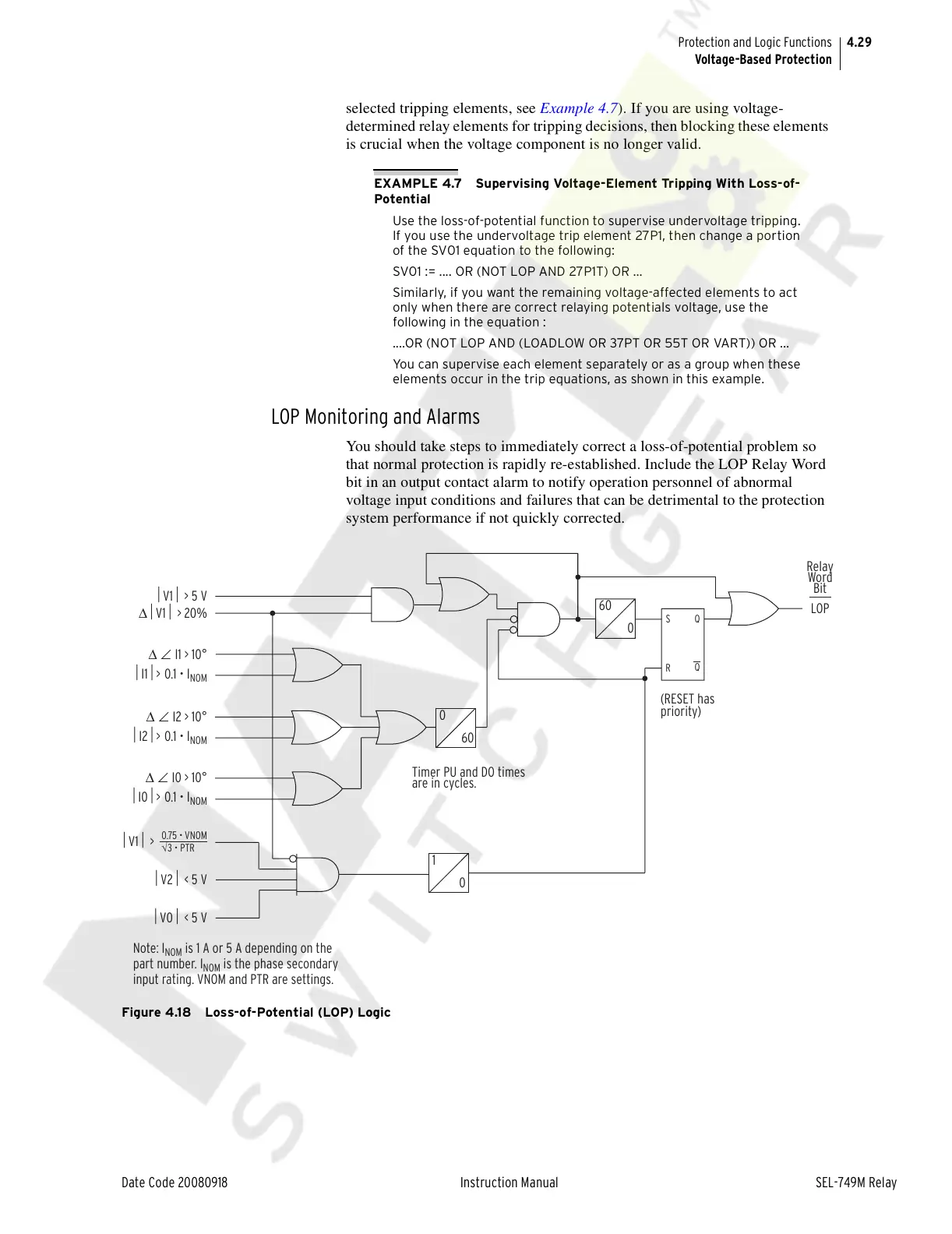
You should take steps to immediately correct a loss-of-potential problem so
that normal protection is rapidly re-established. Include the LOP Relay Word
bit in an output contact alarm to notify operation personnel of abnormal
voltage input conditions and failures that can be detrimental to the protection
system performance if not quickly corrected.
Figure 4.18 Loss-of-Potential (LOP) Logic
60
S
R
Q
Q
0
0
60
1
0
Relay
Word
Bit
LOP
Timer PU and DO times
are in cycles.
⏐V1⏐ > 5 V
Δ⏐V1⏐ > 20%
Δ ∠ I1 > 10°
⏐I1⏐> 0.1 • I
NOM
Δ ∠ I2 > 10°
⏐I2⏐> 0.1 • I
NOM
Δ ∠ I0 > 10°
⏐I0⏐> 0.1 • I
NOM
⏐V2⏐ < 5 V
⏐V0⏐ < 5 V
⏐V1⏐ >
0.75 •
VNOM
√
3 • PTR
(RESET has
priority)
Note: I
NOM
is 1 A or 5 A depending on the
part number. I
NOM
is the phase secondary
input rating. VNOM and PTR are settings.
Courtesy of NationalSwitchgear.com


 To Next Page