
 Need help?
Do you have a question about the SICK FLOWSIC200 and is the answer not in the manual?
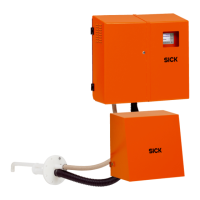
The FLOWSIC200 is a flow velocity monitor designed for non-contact measurement of flow velocity and air temperature, primarily in traffic tunnels (road, railroad tunnels) or other tunnel facilities. It operates on the principle of ultrasonic transit time difference measurement.
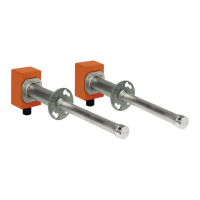
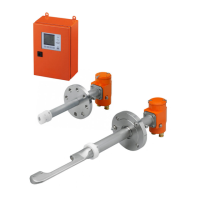
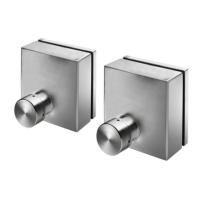
The system consists of two sender/receiver units (FLSE200) and an MCU control unit. The FLSE200 units, mounted on opposite tunnel walls at an angle to the gas flow, alternately transmit and receive ultrasonic pulses. Piezoelectric ultrasonic transducers within these units emit sound pulses at an angle α to the flow direction. The transit time of the sound varies depending on the flow velocity and the angle, due to "acceleration and braking effects." The flow velocity (v) is determined from the difference in these transit times, independent of the sound velocity itself. This method ensures that fluctuations in pressure or temperature do not affect the flow velocity measurement. The air temperature is also determined from the calculated transit times, leveraging the temperature dependency of sound velocity. This simultaneous detection of flow velocity and temperature can be used to warn of icy conditions.
The MCU control unit manages data transfer and processing from the sender/receiver units via an RS485 interface. It provides signal output through analog and relay outputs (for measured values and device status, respectively) and allows signal input via analog and digital inputs. The MCU also supplies voltage to the connected sender/receiver units and communicates with host control systems via optional modules (Profibus DP V0, Ethernet, MODBUS). System and device parameters are easily configured via a USB interface using the SOPAS ET operating software, with parameters reliably stored even in case of power failure. The control unit is typically housed in a stainless steel enclosure.
A check cycle can be triggered manually or automatically to test the correct functioning of device components. This cycle includes a zero-point control and a span test. Deviations from normal behavior are output as warnings or errors. The zero-point check ensures transmission signals from transducers are read back without delay and with the original waveform, calculating the exact zero point. The span test determines the time difference between signal transmission directions and computes it with system parameters to establish a velocity offset at the zero point.
The FLOWSIC200 measuring system is designed for ease of installation and operation. Sender/receiver units are mounted on opposite tunnel walls, with an angle between the measuring axis and tunnel axis not significantly greater than 60° (minimum 45°). Proper alignment of the sender/receiver units is crucial for accurate measurement, allowing for vertical rotation and horizontal tilting to adapt to local conditions. The system can be configured via the SOPAS ET software using a laptop/PC connected via USB, enabling easy parameterization, data storage, and graphic displays. An optional LC display module on the MCU provides direct access to measured values, status information, and control buttons. The system supports bus wiring, allowing up to eight sensors to be connected to one MCU. Hardware or software addressing can be used for sender/receiver units.
The FLOWSIC200 requires regular maintenance, primarily limited to cleaning system parts from external contamination. Before maintenance, the system should be set to "Maintenance" mode via an external switch, SOPAS ET software, or the LC display. Maintenance intervals depend on local conditions, typically more than 24 weeks, with some units (FLSE200-H and FLSE200-HM) allowing up to 5 years. For FLSE200-M units, protective tubes must be covered during tunnel cleaning to prevent water from reaching the ultrasonic transducers. Direct contact with FLSE200-M transducers should be avoided during cleaning, using methods like careful blowing or a soft brush. All maintenance work should be documented in a Maintenance Manual and carried out by qualified personnel. SICK offers consulting services and maintenance agreements for specific applications.
 General
| Brand | SICK |
|---|---|
| Model | FLOWSIC200 |
| Category | Measuring Instruments |
| Language | English |






 To Next Page